
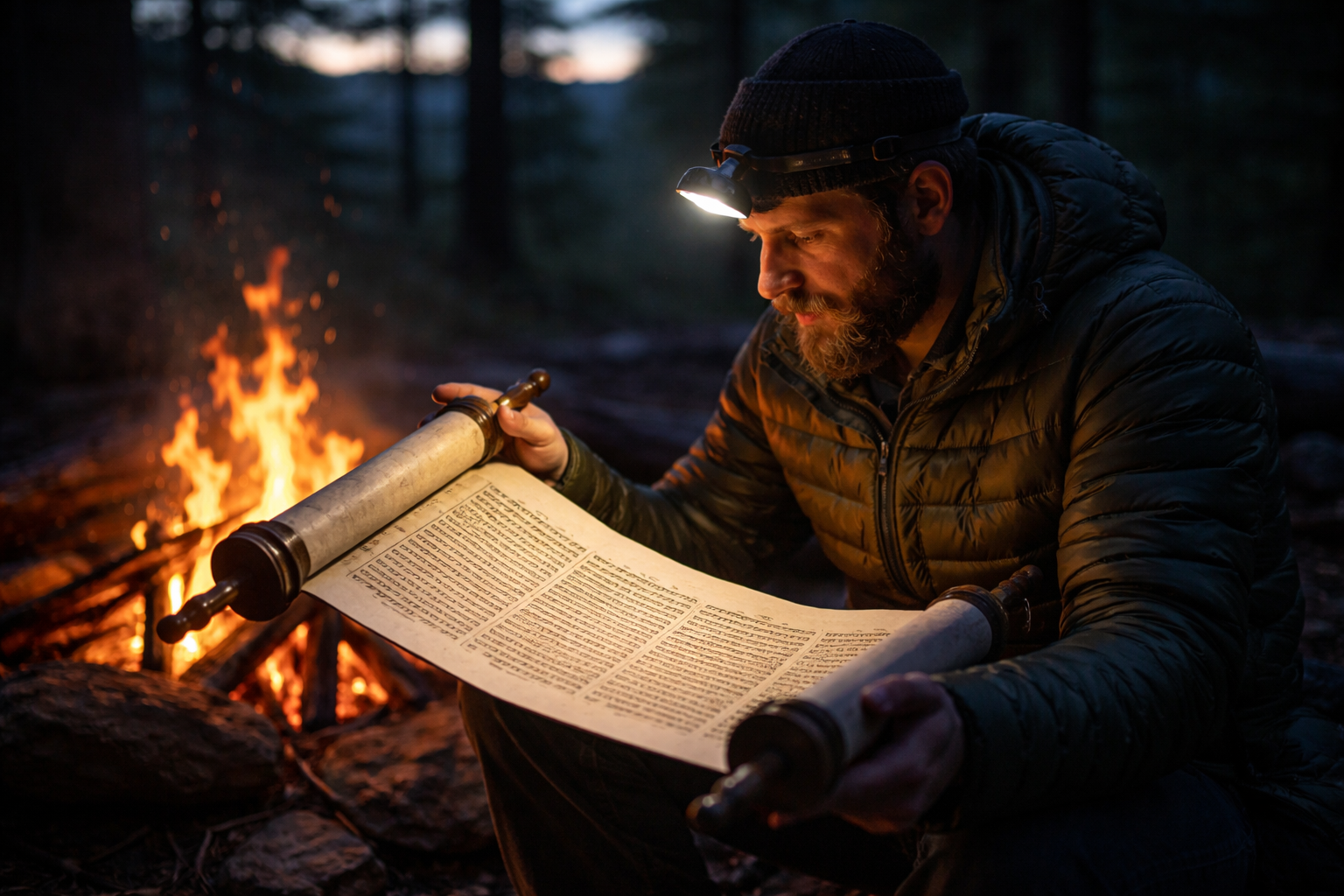
If you’ve ever spent a night in the backcountry, you already understand Purim in a way most will not.
It’s not the costume parade version, not the getting sloshed, and not the children’s sugar rush.
It’s the deeper meaning beyond graggers and the mitzvot and megillah. Those are so important, but we’re an outdoor effort, so we’re going to make it about that.
Megillat Ester reads like a palace drama set in Shushan. It’s full of royal decrees, political intrigue, banquests, betrayal, and ultimately, vindication. It’s urban and imperial.
And yet, I would assert it is still a wilderness text.
When You’re Far from Power
Backcountry hiking begins with the decision to leave infrastructure behind for a time.
You won’t have a cell signal or data service. There are no quick exits, and definitely not even a guarantee that the weather will hold and you will be safe.
I think that is the position of the Jews we find in the Megillah, which consequentially, is perhaps the first book where they are specifically referred to as Jews. They are scattered across 127 provinces of the Persian Empire. They are far from their sovereign, exiled from their Temple, far from any control over their lives. They are living under someone else’s system, dependent on forces they cannot control.
Anyone who has watched a weather front roll in faster than expected knows this feeling. No matter how carefully you plan, no matter how well prepared you may be, ultimately, you are small under the sky.
Purim begins with precisely that same sense of scale. Jews don’t even factor in to the start of the story until Mordecai refuses to bow to an officer of the court.
The God Who isn’t Named
If you have a “things rabbis will say about Purim drinking game,” invariably, it will be pointed out that God doesn’t appear in Esther’s story anywhere.
I think we constantly point this out because there’s a degree of theological discomfort in that. Last year, Nezzie and I pitched on a ridge in the Maine mountains after running out of daylight, it’s actually a familiar feeling.
In the backcountry, God isn’t any more obvious. There is wind, rocks, hunger, fatigue, beauty, risk, and so many other things. You don’t see providence the way you see a blue or white blaze on a tree. You infer it. You see patterns. You look back and realize a narrow escape down a ridge from a lightning store may have been the hidden hand of something, well, bigger.
I think Purim trains us in that kind of noticing.
God is concealed in coincidence, the right people in the right place at the right time. Circumstances turn favorable. The king’s insomnia, a conversation overhead, Esther’s improbable escalation to a place of prominence with the king…it’s all there.
Concealment isn’t the same as absence, we learn. There’s a reason why we find God in the wilderness so often, because the subtleties of Creation stack up.
Esther at the Trailhead
There is a moment in the Megillah when Esther stands at a threshold. She has to decide whether to approach Ahashverosh without being directed to, which is a potentially capital offense.
It’s kind of a trailhead moment.
I don’t feel this on a weekend hike, but I do feel it on undertakings like a thru-hike of the John Muir Trail or the Appalachian Trail.
Am I really doing this? you ask yourself as you sling your pack on your shoulders and leave the gravel parking lot behind you.
Esther’s decision is not triumph, but rather, “if I die, I die.”
That’s the language of risk!
Most backcountry travellers understand this innately. Risk mitigation, training, preparation do not eliminate uncertainty. I don’t think hiking is courageous, not in any useful sense, but you move forward with a certain degree of surrender.
Costumes and Camouflage
I’m not one for the clamor of Purim. I also don’t like synthetic Halloween costumes recycled for this holiday. My daughter, Nezzie, makes her own costumes, which I love, avoiding the intrusion of the consumer mindset into the holiday.
The deeper theme, of course, is concealment.
In the wilderness, concealment is about survival. In Maine, snowshoe hares change color with each season. Seeds lie dormant underground for months before breaking open. The forest in the winter can look dead (unless you live in Maine with its surplus of pines), but it’s still teeming with life.
Esther conceals her identity while Mordecai urges tactics and strategy from background. Even the divine presence is camouflaged in the folds of ordinary events.
The backcountry teaches me the same lesson: what looks empty is often full. The white silence is still very much alive. There’s a whole ecology in play that isn’t immediately obvious.
Joy After Survival
When the danger is over in the Megillah, the response isn’t quiet relief, although I’m sure there was some. Our response is festive and celebratory, a time to exercise generosity and public joy.
You can find the same joy, I think, standing atop Mount Katahdin at the end of the Appalachian Trail. Breaking through the treeline and to an open summit, there’s an earned sense of excitement and jubilation you don’t find at the foot of the mountain.
You’ve got sore muscles, windburn, sunburn, but you’re going to have the best memories of it. The experience of the Jews in Persia, I imagine, was like that. We were vulnerable. There was a real threat to our survival, and just as today, the persistent realization that the outcome could always go differently, in no small part because we know it has.
I don’t think the Megillah’s “light and darkness and joy and honor” is naive optimism, just post-storm rays of light peaking through.
I do think the optimism is trite, to a certain degree. We do the “they tried to kill us, we survived, let’s eat” thing, but the subtext is that our celebrations are a therapuetic salve to our national soul. Sometimes, they really did kill us, and there was no hanging of Haman and his sons at the end. Either the killing stopped or they ran out of Jews to kill. The celebrations are our way through.
And for me, that’s the same story. I get back to the trailhead on a Sunday. The next day, I’m back in “real life,” where I lose that connection I find in the wilderness. Reality sets in at the end of Purim.
Reading the Megillah Under Open Sky
What if we read the story outside this year?
I mean, here in Maine, we still have a couple of feet of snow that hasn’t melted yet. It’s end of February, beginning of March. We still have more than a month of winter conditions.
But imagine reading the Megillah by a headlamp. Hearing Haman’s name swallowed by wind instead of graggers and sactuary acoustics. Passing mishloach manot from pack to pack. On the Appalachian Trial or Pacific Crest Trail, which sees hikers embarking about now, giving gifts to those in need as a “trail angel.”
Purim teaches about survival when we don’t control our circumstances, and the outdoors is always a master class in that truth.
The Hidden Trail
There’s a final wilderness connection that feels very Purim-like.
Years and years ago, we did a two week ramble across the breadth of Wrangel-St. Elias National Park in Alaska. There was no trail to follow, just a nebulous route with a compass and a map. You had to look for terrain features, find identifiable points in the distance as a reference, and use a compass and maintain a pace count.
The divine in the Megillah works much like that.
Purim isn’t about obvious miracles. It’s about assuring us that even in exile, and especially in times of political chaos, when God’s name is nowhere on the page, there is still a story unfolding around us.
On a long hike, where you’re following the gravel braids in a river, you only recognize the miracle after you’re at journey’s end.
For me, that’s why Purim belongs outdoors.
(In fairness, I think every Jewish holiday belongs outdoors)
Leave a Reply