
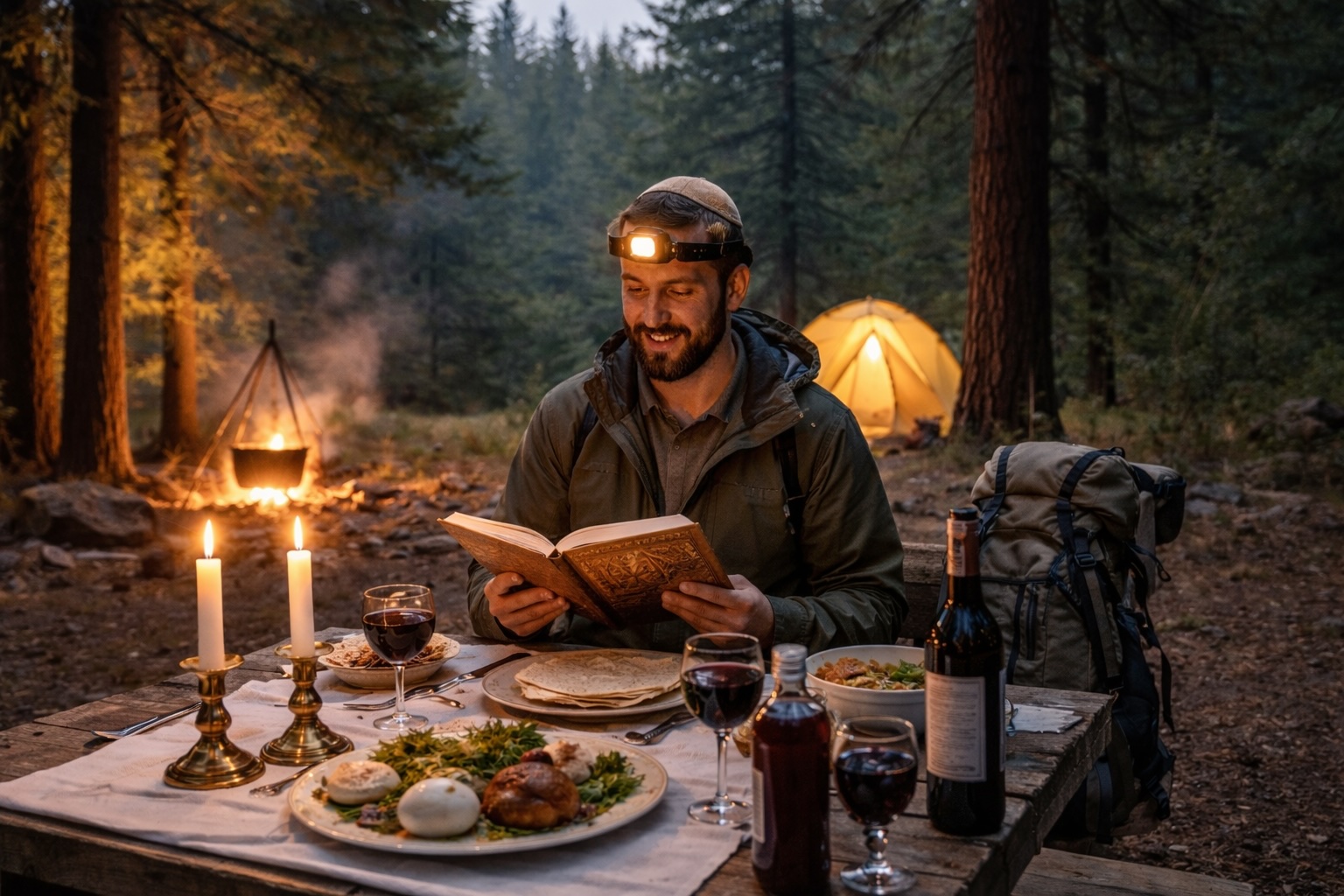
The fire burned down to a bed of coals by the time they reached Maggid, recounting the story.
The Appalachian Trail stretched nort hand south in a narrow corridor of shadow and pine, a ribbon of dirt that held what little warmth collected during the day, even as the April night cooled around them. Somewhere below the ridge, water moved steady and unseen. Above, the sky had opened between naked branches, a scatter of stars caght in black limbs.
Eli adjusted his headlamp, then clicked it off.
“It’s too bright,” he said.
Nearby, Jonah was wrapped in his sleeping bag like a cocoon, only his nose and glasses visible. Gripping his Haggadah from within his down casing, he looked like a weird amusement park mascot.
Eli got to “ha lachma anya…” and hesitated.
The words stayed in the cold air, colliding with the smell of woodsmoke and damp earth.
“This is the bread of affliction,” he finished softly, putting back down the matzah, which lived in a plastic freezer bag. It had broken into uneven shards during the hike. “…which our ancestors ate in the land of Egypt.”
Miriam laughed. “Also, it’s the bread we packed badly, and this is what survived.”
They did not plan it this way.
The original idea was simple: finish the stretch from Springer Mountain to Hot Springs by early April, then catch a bus to Atlanta in time for Passover. Weather, blisters, and a stubborn insistence on “just one more ridge” stretched their timeline until the calendar caught up with them somewhere in the Smokies.
So, they stayed and resolved to do a seder on the trail. A friend met them around Fontana Dam and delivered a 5-lb box of matzah, which the travelers distributed among them. It would carry them, along with some tuna, through both the Yom Tov and chol chomoed days of Pesach.
“Freedom is wherever you are,” Eli declared loftily that afternoon, unpacking supplies at the shelter. “Or at least whevever you decide to stop walking.”
They had improvised everything. The seder plate was an old mess kit lid. Bitter herbs were dandelion greens Miriam insisted were “definitely edible.” The charoset was a mixture of apples given by a “trail angel” at the last major road crossing, and some nuts carefully picked out of trail mix, with a splash of Manischewitz for effect.
They had a chicken bone with some gore on it for the shankbone. The egg…the egg had been the hardest. Jonah carried it for two days, nested in a sock, protecting it like contraband. When he finally pulled it out, it was miraculously unbroken. There had been a moment of genuine awe.
Now, deep into the telling, their voices rose and fell with the rhythm of the text.
“We were slaves to Pharoah in Egypt…”
“Now we’re slaves to this trail,” Jonah muttered. He was the least enamored of their thru-hike, coming along mostly for fear of missing out.
“No,” Eli corrected. “We’re choosing it, and that’s the whole point.”
Miriam leaned back on her hands, looking past them into the trees.
“My grandmother at our seders used to say every generation has its own Egypt,” she said. “Not always a place.”
They thought for a moment about some of the hostility they had met from other hikers on the trail. A kid on Blood Mountain sporting a kaffiyeh and a lot of opinions. The trio didn’t have an answer for him, but he harassed them for a solid day until severe chafing took him off the trail. They weren’t there to talk about Israel or Gaza, though they had all done Birthright together. They were there to hike. Not that they minded when they heard he came off the trail.
Jonah gestured all around, possibly to the dark woods, their worn packs, the endless miles behind and ahead. “All of this is definitely suffering.”
Miriam was quiet for a moment, and said, “I think it might actually be the leaving, which was actually headed towards something else.”
None of them were particularly religious, but as Jews are wont to do, they still were finding meaning in both Passover and their thru-hike.
When they reached the Four Questions, they again paused.
“None of us are kids, really,” Jonah said. “Who asks?”
Miriam and Eli put their fingers on their noses and declared, in unision, “Not it!”
Jonah sighed, straightened slightly in his sleeping bag, and said, “why is this night different from all other nights?”
They let the question hang for a moment. The forest definitely wasn’t going to answer.
The night was different than all other nights, and all other Passovers. It wasn’t the improvised ritual objects. It wasn’t that they lit the Yom Tov candles in a windproof candle lantern that they planned on using for the next two stationary days on the trail. No, they weren’t religious, but there was something they wanted to get right. They were in the middle of a long journey largely defined by continuous movement north, always north.
Yet here they were, taking a moment to choose the freedom of stillness and a memory of their people.
Later, they sang. At first they were quiet, possibly a little intimidated by boisterous choral work in the middle of nowhere. As “Dayenu” echoed through the trees, it was somehow softened by pine needles and moss.
“It would have been enough,” Eli said, translating the obvious.
Miriam smiled. “Would it, though? I could do with something a little better than matzah for the next eight days.”
“Probably thats a ‘no’,” Joshua chimed in helpfully.
Then they sang it one more time.
By the time they said, “next year, in Jerusalem,” the fire was nearly gone.
They poured themselves one more mug of the Manischewitz.
“To freedom,” Eli said.
“To getting to Maine before I lose interest,” Jonah added.
Miriam lifted her cup last.
“To knowing when to stop walking,” she said.
Somewhere, in the dark, an owl hooted.
The shelter was only a quarter of a mile from the Appalachian Trail, which waited. It was indifferent and patient, stretching onward from Georgia to Maine.
For that night, though, they stepped out of it. A thru-hike is often a race filled with variables and questions.
Are the contents of my pack necessary to take me to Katahdin? Do I have the right shoes? How many miles do I need to do per day to get to Maine by September?
For the early weeks of a thru-hike, the conversations are in orbit around gear and plans and the hike, insufferably banal conversation that loses track of the beauty of place and time. The point was the journey itself, not the destination as a goal, and stepping out of it for a night was useful.
They made a small circle of light in the vastness of the woods. They remembered that very little in the Exodus story talked about the distance the Hebrews put between themselves and Egypt, just the leaving itself. The meaning was in the motion, and now, the meaning was in the pause for the space of memory.
When they finally crawled into tents or the shelter, the words lingered as something that would carry forward beyond the trail.
Next year…
Maybe not in Jerusalem, or maybe so, but definitely further along the path, closer to whatever freedom might be.
Leave a Reply