Category: Camping

An outdoor activity involving overnight stays away from home in a shelter, such as a tent, a caravan, or a motorhome. Participants spend time outdoors in more natural ones in pursuit of activities providing them enjoyment.

  • Getting Back to Fundy-Mentals

    Getting Back to Fundy-Mentals

    From where I live in Maine, I have an embarrassment of hiking riches.  I’m four hours or so from Jacques-Cartier, an hour from both Baxter State Park and Katahdin Woods & Waters National Monument, a half hour to forty-five minutes from Acadia.  Looking for my usual Memorial Day escape this year, I entertained doing Evans Notch, a DIY loop trail in White Mountain National Forest between New Hampshire and Maine.  The only problem was, with a rare, spring Nor’easter on its way, there was snow in the forecast.

    Looking around, I saw that Fundy National Park was within striking distance, a mere four hours away from where we live near Bangor.

    The Journey May Be the Best Part

    If you’re coming up I-95, you can cross at Houlton and take Trans-Canada Highway 2 most of the way.  Coming from our area, we take the venerable Airline, Maine Route 9, to Calais and cross there, taking the Fundy Coastal Route.  I stopped at all the “Saint” towns along the way, culminating with St. John as Shabbos approached.

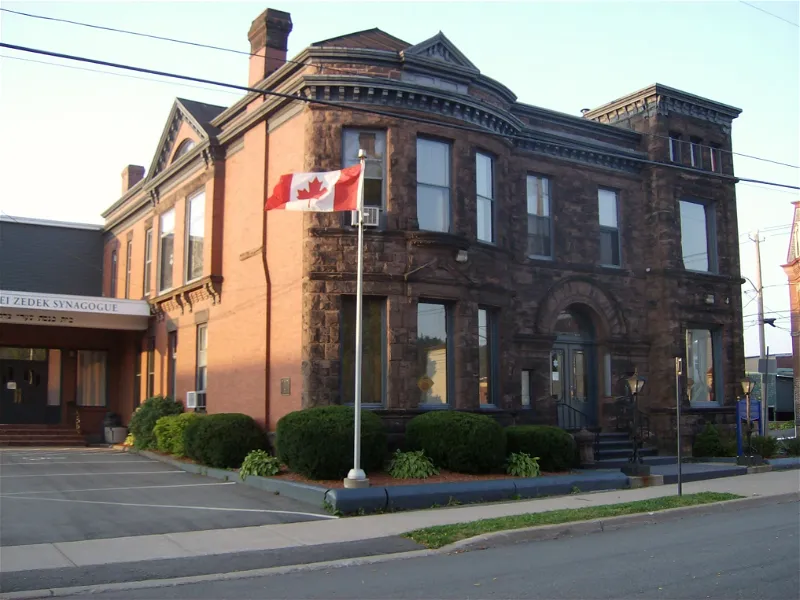
    I always like to visit Shaarei Zedek, a Conservative synagogue in St. John with a lovely building and an attached museum.  After services, I checked out the Reversing Falls.

    Saint John Jewish Historical Museum (Saint John) - Visitor Information ...
    Shaarei Zedek in St John
    Reversing Falls in St John

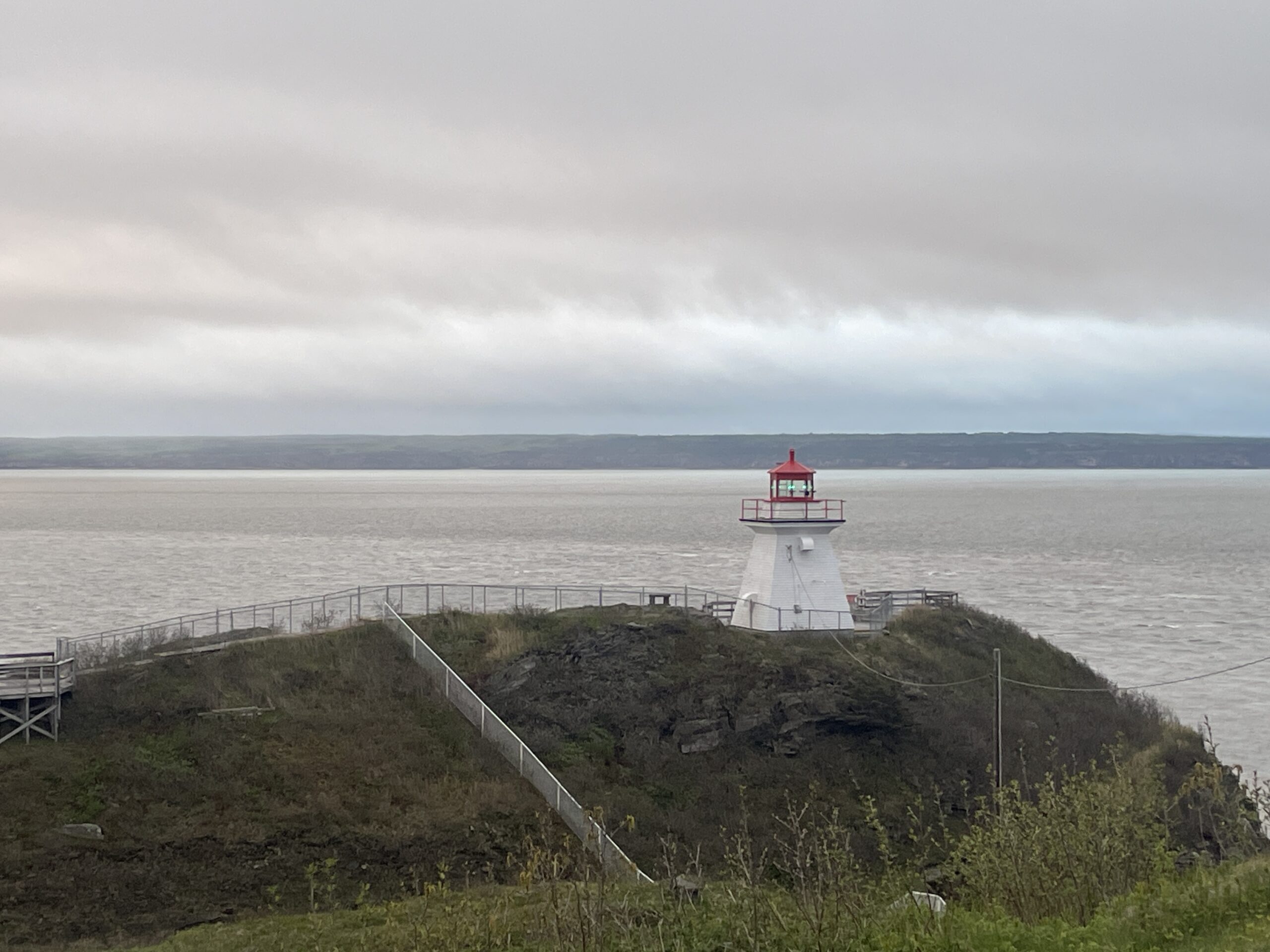
    After Shabbat, continued on to Moncton, and then stopped at Cape Enrage.  I was too early for the iconic Hopewell Rocks, but it’s nice to save something for another trip.

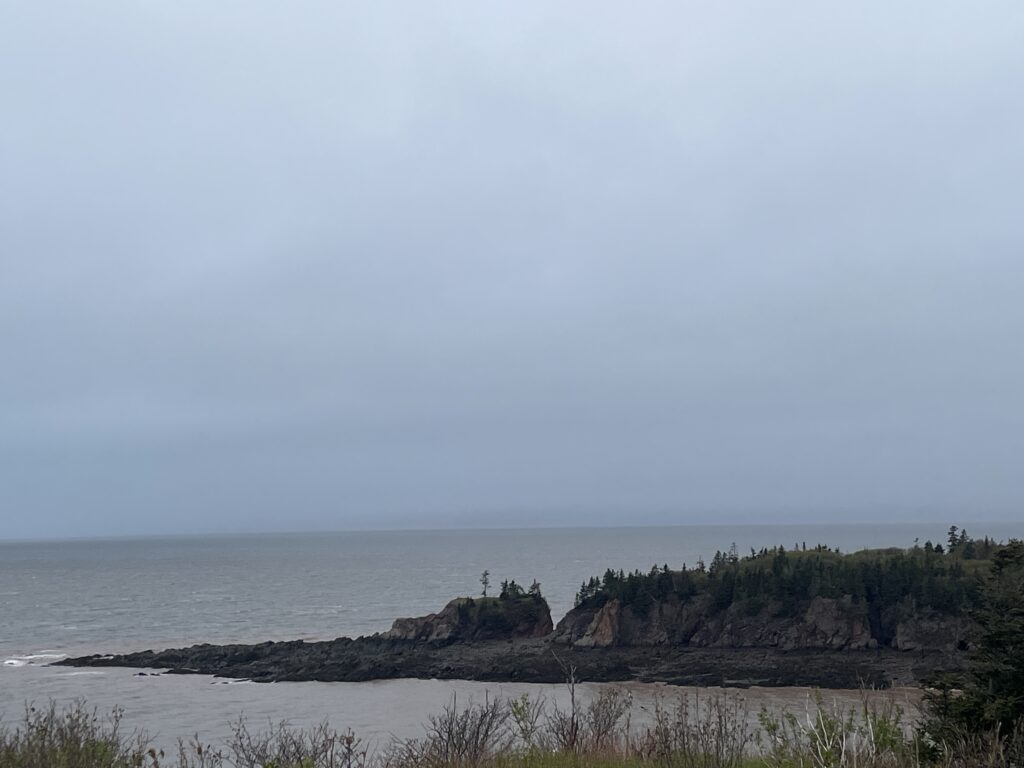
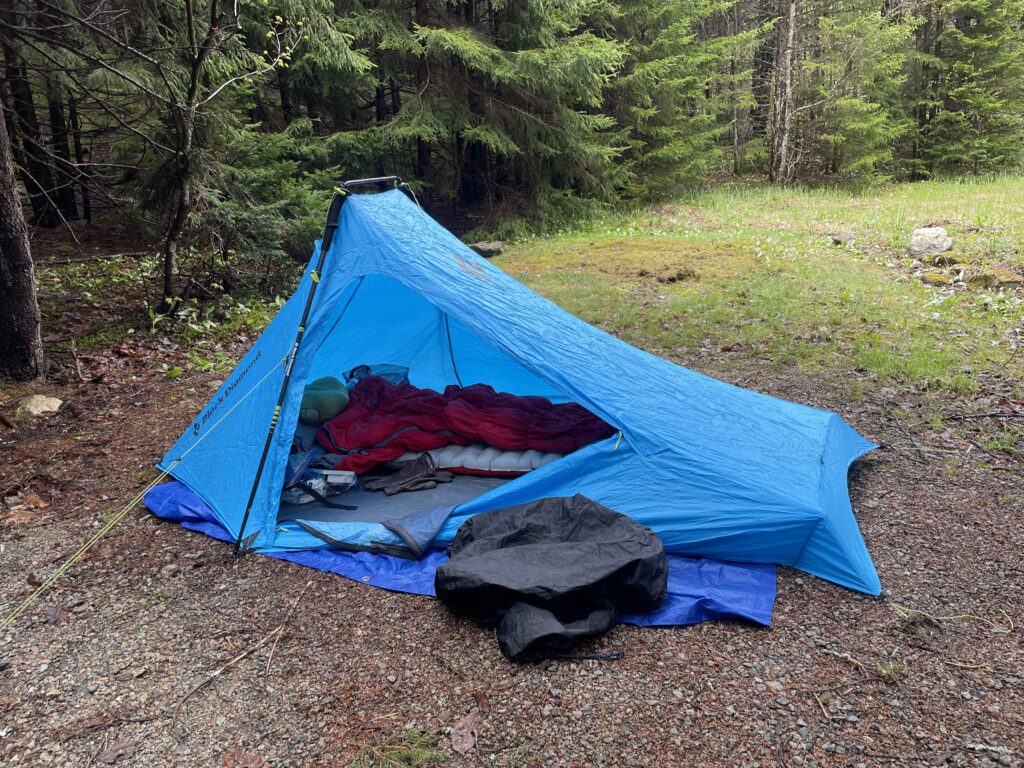
    Finally arriving at the Alma entrance to the national park, I took in the coastline, checked in with the park, and started my hike in a mild downpour.

    The Fundy Circuit

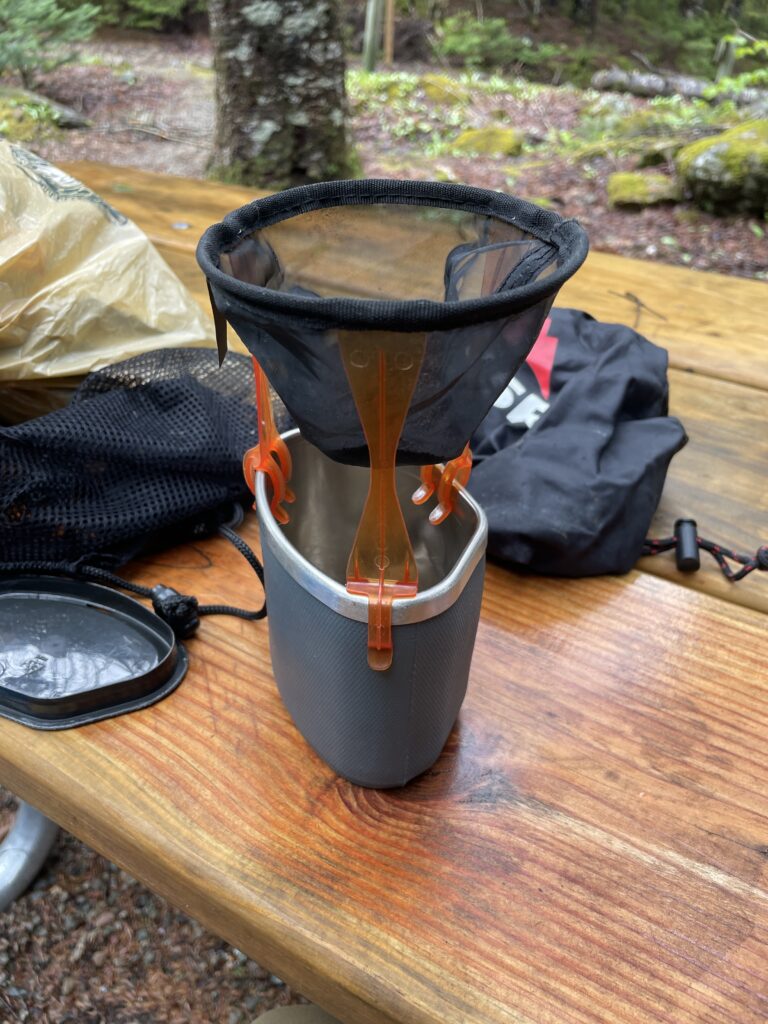
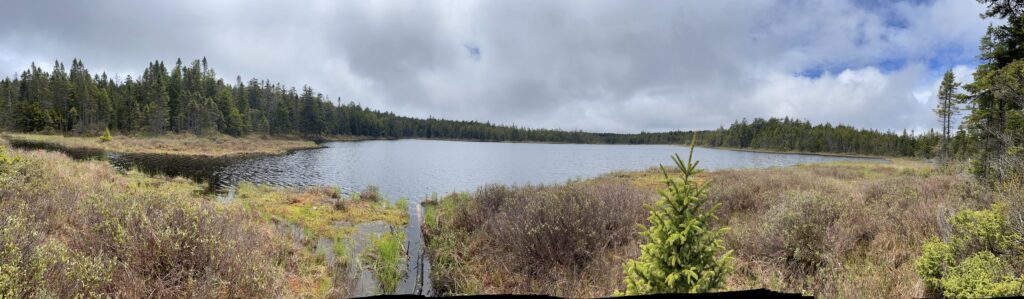
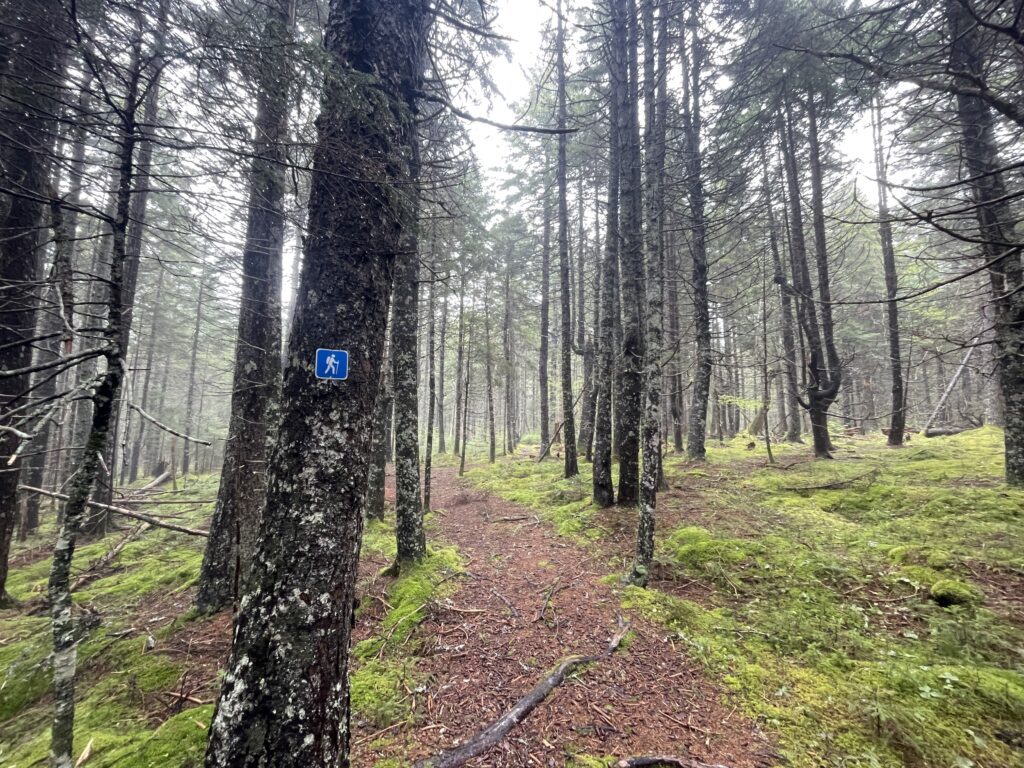
    This 28 mile hike was, to me, kind of “meh.”  There are some unbridged river crossings, but as far as a backcountry experience goes, even the Cutler Coast in Maine’s Washington County felt a little more dramatic.  Most of the hiking is inland, which is fine, but the scenery was limited to some lovely lakes, a gorge, both slow and fast-flowing rivers, and green tunnels.

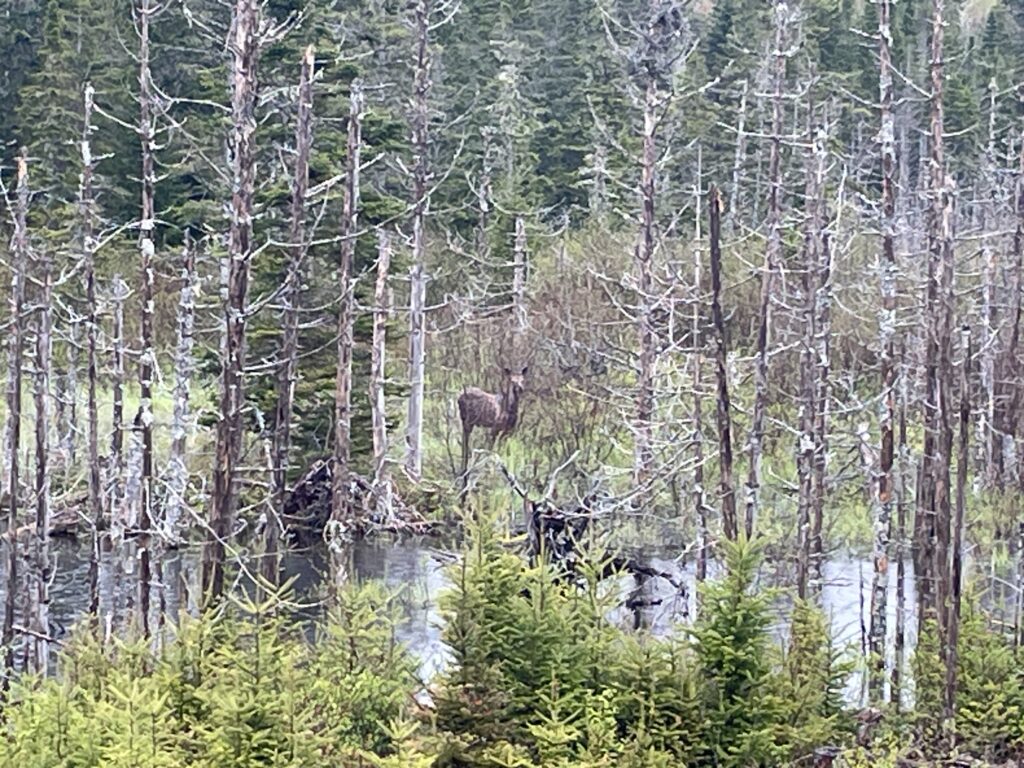
    Still, I sighted any number of moose.

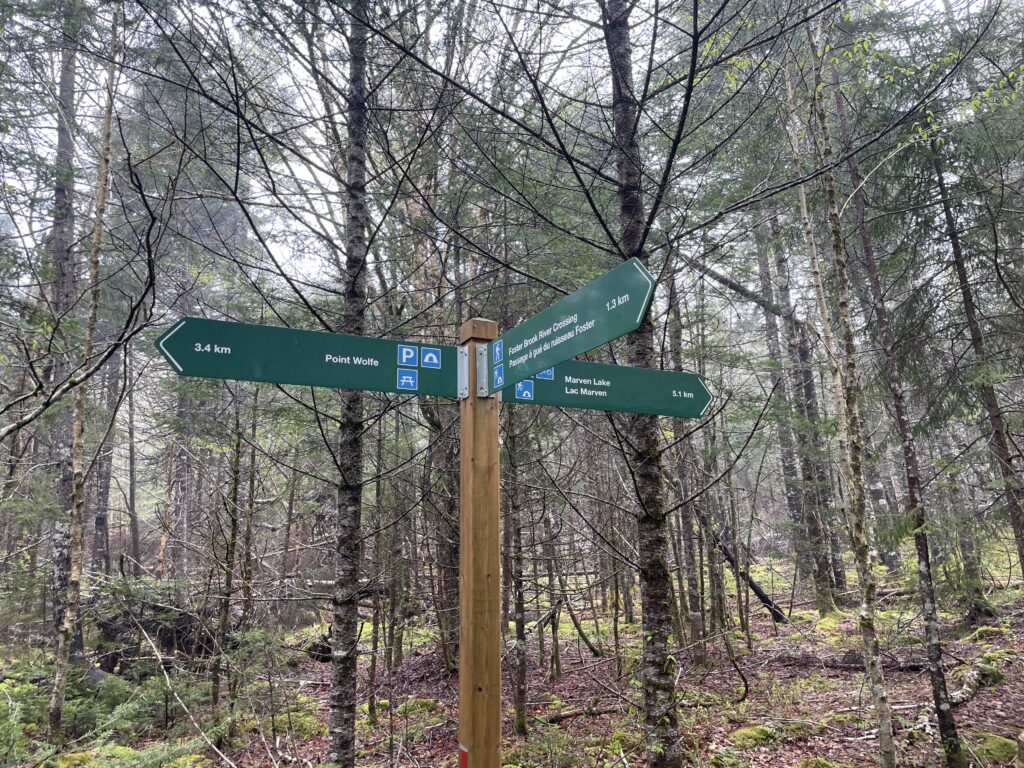
    Some notes about hiking in Fundy…backcountry sites require a fee-based, prior reservation with Canada’s national park system.  For the circuit, there are only a handful of options.  For me, I did day one at Marven Lake, and day 2 at Tracy Lake.  There are no options past that, so I recommend doing the hike clockwise, and saving the heavy Salmon River crossings for the end of the hike.  You spend less time with wet feet as a result.

    I beat black fly season by a hot minute, which was already in full swing in Maine.  It was also very rainy, which made the river crossings a little more hazardous.  One was cabled, another was not.  I watched a guy with a small dog attempt one of the crossings a few times, forcing his small dog to try and swim it.  Don’t be that guy.

    A Note About Jewish Safety

    Israel has issued a revised travel advisory for Jews in Canada.

    Travel Advisory
    Tel Aviv: The National Security Council (NSC) of Israel on Sunday issued a travel warning for Canada, citing an occasional threat to its citizens and Jews in the North American country. Issuing a message to Israeli citizens residing in or visiting Canada, the NSC requested them to take extra precautions, especially in public areas. It also suggested not to display Israeli or Jewish symbols, remaining alert for any kind of threats. The guidelines were issued following a rise in anti-Israel incidents targeting Jewish institutions in Canada over the past 18 months. The anti-Israel incidents included shooting, direct threats to Israelis or Jewish people and Molotov cocktail assaults.

    There was some serious vandalism at the synagogue in Fredricton, New Brunswick in recent months, so this may or may not extend to the Canadian Maritimes.  I thought hard about hiding my yarmulke when crossing the border, but my license plate literally has “JEW” in it so, kind of hard to obscure something so key.  At any rate, the Canadians I met were very kind.  My Jeep left the Fundy parking lot with yet another duck on the door handle.  Don’t believe the hype, it’s probably places like Toronto or Montreal.  We’ve visited Quebec several times, however, since October 7th with no problems.

  • Memorial Day

    Memorial Day

    When my unit returned from its Operation Iraqi Freedom mobilization, I had a conversation with my friend, Jimmy. I came home early due to a custodial matter, but we stayed in touch for the duration of the tour. He did well, he really came alive in Baghdad. He wanted me to volunteer and come with him for the Afghanistan mission with another unit from the Pennsylvania Guard. For a variety of family reasons, I could not, but I wish I would have.  He was a good friend and a cunning warrior.
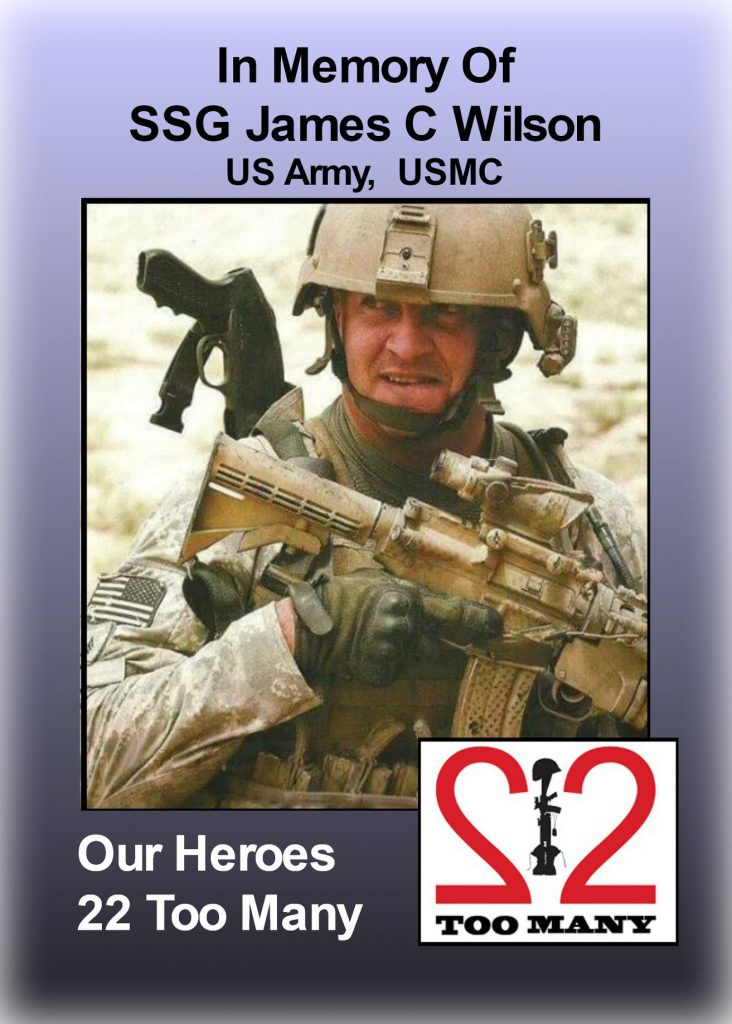
    Shortly after his return from Afghanistan—we hadn’t reconnected—after wrecking his vehicle, while waiting for responders, Jimmy took his sidearm and took his own life.  There’s been a lot of speculation in the decade-plus that’s followed.  Many think PTSD.

    I’m never sure about that diagnosis.  Jimmy was a loud, obnoxious, prior-service Marine with a heart of gold buried deep.  I often share the story of what a soft touch he was with the citizens of New Orleans when we helped out in the aftermath of Hurricane Katrina.

    I think that in many cases, it’s the return to the mundane that does many soldiers in.  The sharp contrast between The Most Important Thing You Will Ever Do In Your Life that comes with wartime service and the rest of your world after.  It was something my late, great-uncle, a Marine veteran of Iwo Jima and Guadalcanal, warned me of, the sense that the only noble purpose he would ever have boils down in his own words, “in how many Japs I killed and how many friends I lost until we won.”   He found the truth:  a life well-lived and enjoyed, being a husband and a father, far surpassed the horrors of war in terms of nobility.

    What dignifies and reflects your belief in God? This question posed by my great uncle was expressed somewhat differently, but that’s what I took away from his letters to me when I was in infantry school.

    I think Jimmy couldn’t detach his assumed value from being wound up in his martial professions.  With the possibility of consequences in the Guard and in his job as a police officer for drunk driving, I don’t think he could see his worth extending beyond the immediate troubles.  I wish he could have asked any one of his good friends for help.

    And while we honor him, Memorial Day ends up being a paean to the virtues of sacrifice in combat.  Jimmy may be mentioned, but there’s always going to be an asterisk.  He’s fodder for anti-suicide campaigns, but in that he’s only a pitiable figure, not a resolute combat leader that bravely led successful missions and brought his men home safely.

    *

    She sobbed in the passenger seat of my car.

    I drove her to a town an hour away where she faced a hearing for driving under the influence.  We managed to get things transferred to the Lancaster County Veterans Court.
    Rabbi Jack Paskoff of Shaarai Shomayim in Lancaster pushed me towards this a few years before, in a role as a “veteran mentor.”  He knew I was looking to act on the open wound that was Jimmy’s suicide, and my own struggles with overseas service.  A local judge, whose wife was a member of the congregation, was standing up a diversion program specifically for veterans in our county, an opportunity to give them a second chance rather than saddle them with felonies and misdemeanors that would follow them.  All a veteran had to do was have an honorable discharge; combat veterans were not the sole recipients of this legal largesse.  As a mentor, I was like an AA sponsor, helping them stay on a path of sobriety, helping them with a restorative justice project that was required, and if they had license suspensions or probationary sanctions, helping them deal with those.

    I had some qualms about giving people who served in peacetime a chance when there were veterans whose criminality was directly associated with their service, until I met this young woman.  As more female and trans veterans came through the program, it became obvious that a court modeled after drug court or a 12-step program was not going to be sufficient for helping those with Military Sexual Trauma.  She never deployed, but she suffered greatly at the hands of her fellow Marines.  This program was never going to help this young woman so long as it forced her to relive the trauma of her rape, the details of which are only ever her story to tell.  And what was done to her cost her so much, including a presence in her children’s’ lives.

    That day that she cried in my car, I worried that she’d opt out on living in the same way so many of my friends have.  Today, she is doing well.  She is health and happy, and it’s not because of anything the system has done for her.  It’s her own strength, and reuniting with her community and family.

    That time I spent with her was deeply affecting.  I decided after that I would strive to make a difference as a non-commissioned officer, especially after I moved from infantry, which was all male at the time, to logistics.  I took my final break in service from 2020-2022, during which a former soldier contacted me about her own rape, and the insufficiency of the Maine National Guard’s response was exposed by the Bangor Daily News.  When I came back in the service in 2022, I was told during my initial counseling in my unit that some felt “I had betrayed the Guard” in both speaking to the paper and testifying before the state legislature about the culture of misogyny I witnessed.  In many ways, I wear that like a badge of honor.  Very few male soldiers speak up or spoke up about what they’ve seen or done themselves, or their own status as survivors of sexual assault.  It’s something I see improving in terms of training and a “see something, say something” culture in uniform.

    During my testimony, I told a highly personal experience of my assault, when during a hazing ritual 30 years ago at the 101st, I was subject to an act of a sexual nature, causing humiliation and bleeding.  I hadn’t spoken of that in 25 years.  I even became close with my team leader, who did it.  It’s a strange, horrible thing, and I am glad our military culture is reshaping itself.  We’re trying to drive a stake through the heart of the “good old boy” system, and it’s working.

    Nevertheless, I still see the cost to people still harmed by toxic culture every drill weekend.  I hear it in the voices of survivors who will never see justice.

    I’ve become treasurer of The Sisters in Arms Center, Maine’s only female veteran focused transitional living.  We’re working hard to provide a home for female and trans veterans, but we’re also trying all the time to expand our services to survivors of Military Sexual Trauma.  Most of my work centers on budgeting and fundraising.  The heavy lift is done by our Executive Director, who also is a commissioned member of the Maine Army National Guard.  It’s purposeful work, and while I hate that there’s a need for it, it’s not a legislative priority, in spite of the attention on it for over a decade, and funding is in short supply.  Outpatient services from the VA are difficult.  The reporting system, to my mind, is still broken, especially in the Guard or Reserves.

    We held a well-attended viewing of a documentary about Vanessa Guillén at Congregation Beth Israel in Bangor.  I invited speakers from the military and agencies.  The needle moves slowly.  I worry it will be lost when the committed leaders with immediate command of soldiers move on to new roles.  It’s an institutional change that has to be embraced in the same way we treat each generation as having left Egypt themselves.

    We don’t even mention survivors of MST on Memorial Day.  Their service cost them so much, and yet, we’re squeamish about raising the subject.

    *

    These are among the reasons why I struggle with the ceremonies of Memorial Day.  Whether it’s the somber pomp and circumstance of a parade or memorial service, or the festive beginning of summer motif, I feel like there’s so much that was lost to remember.

    It’s that the Reservist or Guard member that deployed, fought, and bled in a Baghdad neighborhood and goes back to an unremarkable career as at best box store middle management, drinking himself to death and driving loved ones away.

    It’s that a woman who was gang raped and driven from the service by the trauma has to watch people who assault her honored with awards and retirement ceremonies.

    You can only hear “freedom isn’t free” by a young essayist so many times before you realize our memorials are as superficial as our concern for an all-volunteer force that is still immersed in a military action that started 23 years ago.  People are often surprised to find out soldiers are still deploying to active combat zones on the same Congressional Authorization for Use of Military Force that kicked off our invasion of Iraq.

    And it’s that much more acute when it comes on the heels of Yom HaZikaron.  Israel puts us to shame with how it memorializes its war dead and the cost to its veterans.

    Every year, I find it harder and harder to abide the way we do Memorial Day.  So I retreat to the woods, and dwell on it by myself standing atop a mountain or by a wilderness brook.

    This year, I’m trying something new. I wrote my thoughts on how Judaism has a salve for moral injury a few years ago, an idea I continue to refine.  Now I’m combining it with enrollment at the Pluralistic Rabbinical Seminary in pursuit of smicha.

    Years and years ago, I finished daf yomi at Siyum HaShas in 2005. I tried my hand at hadar with Chabad Lubavitch, but the movement wasn’t for me any more than the life of a shaliach, though it took me fifteen years to figure that out.  While Leah and I maintain a kosher home and live very Jewishly, inhabiting leadership roles within our community, affixing a label to what kind of Jews we are is less important than producing measurable results in our Jewish community and its intersection with the local non-Jewish world. With the influence and help of two non-Orthodox rabbis I hold in high regard, I was accepted into PRS’ program this year. I want to work on combining the concepts of hitbodedut and the answer Judaism has for trauma in ways that help Jews and non-Jews alike.

    We have the tools in our tradition to do this with. Gemilut chassadim, tzedakah, study of Torah, or a combination of these things “avert the decree” during the Days of Awe, but they also carry manifest obligations.  We are explicitly told what we must do in the rhetorical question posed by a High Holy Days haftarah, “is this the fast I seek?”

    There’s Rambam, too, with his semi-Aristotelian “golden mean.”

    Those substantive tools and concepts may help others get through trauma, in no small part because our traditions have been shaped by millennia of hard times.  I hope to bring that to bear as part of my capstone project, expanding on Nachman of Breslov’s hitbodedut in a manner tightly wound with our tradition and ritual to help others.  There is so much work to do to ply our tradition to sexual assault, which is problematic when it comes to rape—the penalty in Torah is unfathomable today—but October 7th reminds us it is not new to us.  How we heal is so important.

    *

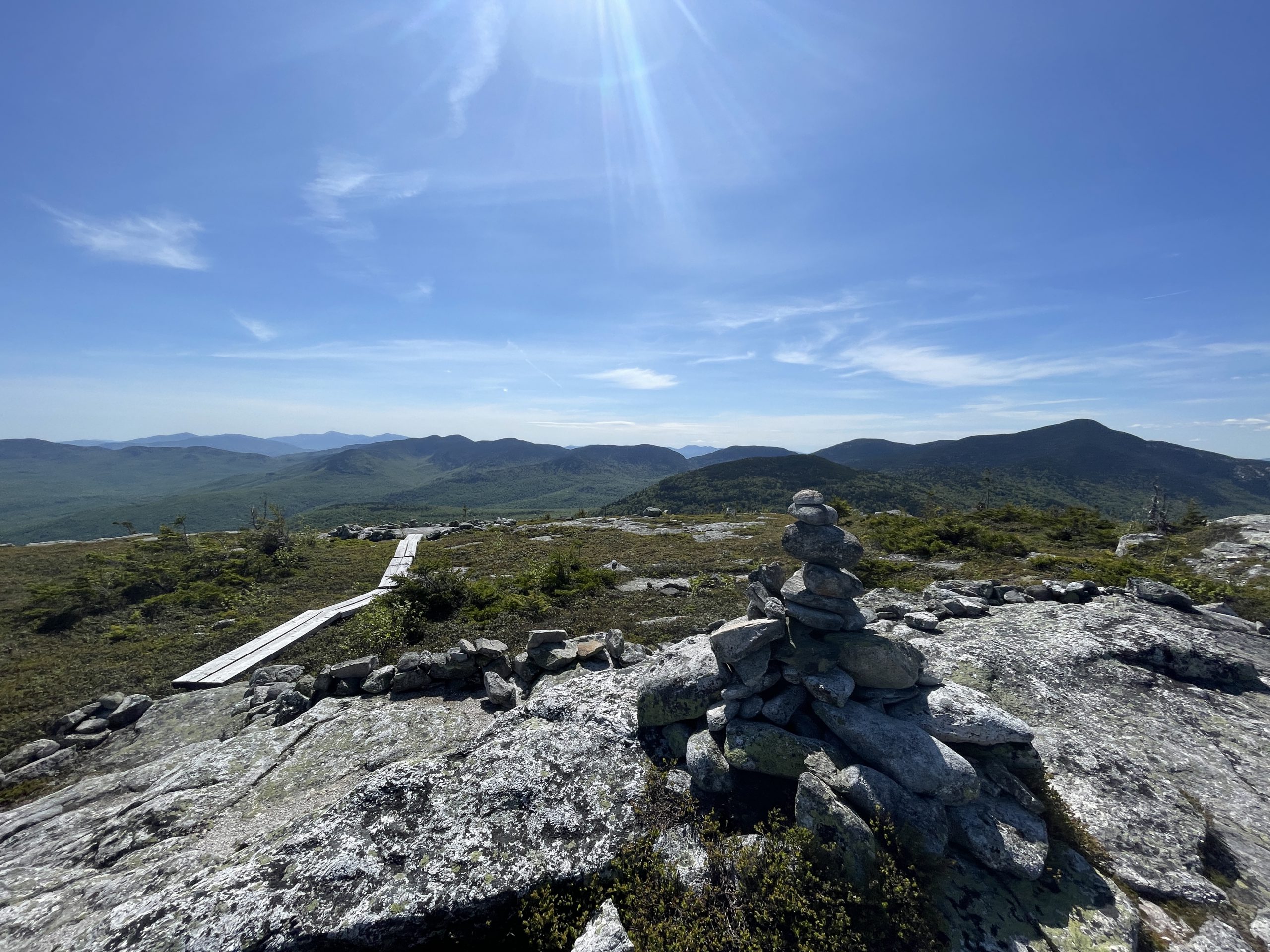
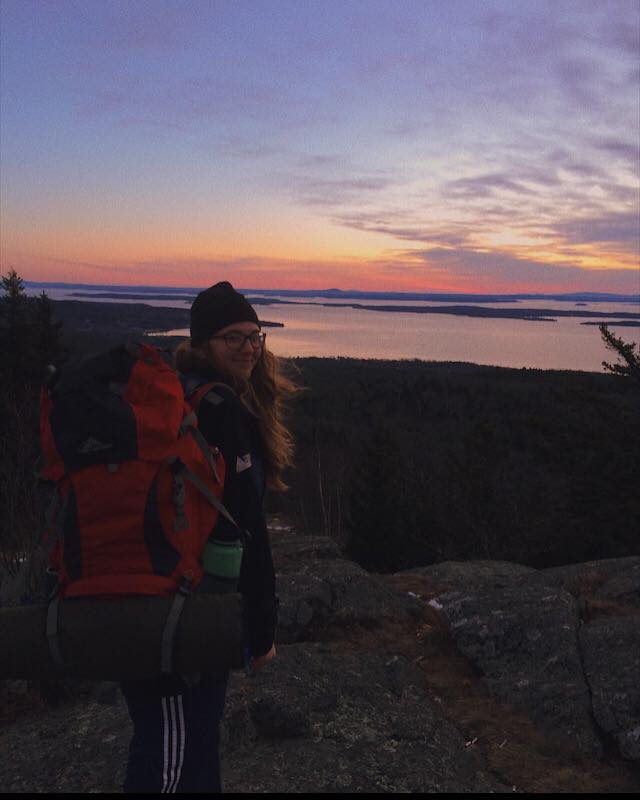
    On the clearest days, with the bluest of skies, and the most aesthetic punctuation of fluffy, white clouds, I stood atop Sunday River Whitecap in Maine and cried.

    The wind was blowing strong.  I adjusted my hat so it fit snugly against my scalp.  From the top of this beautiful peak, I could see the White Mountains in New Hampshire and Maine, the Mahoosuc Range, the valley carved by the Androscoggin River, and the nearby Sunday River ski resort.  It was so beautiful.

    This year I picked the Grafton Notch Loop for my Memorial Day weekend outing.  I invited others, but everyone had other plans or limitations.  Ultimately, this was fine.  I was grateful for the solitude.

    I remembered something from Man is Not Alone by Abraham Joshua Heschel.

    We can never sneer at the stars, mock the dawn, or scoff at the totality of being.  Sublime grandeur evokes unhesitating, unflinching awe.  Away from the immense, cloistered in our own concepts, we may scorn and revile everything.  But standing between earth and sky, we are silenced by the sight.

    Today I feel residual awe.  Today I feel like the world was created for me.  And if it was created for me, it was created for Jimmy.  It was created for every survivor of MST.

    How is there space for self-revulsion and self-hatred when we realize we’re a part of a beautiful Creation?

    I know it’s very reductionist to assume that if I could have stood Jimmy on a mountain top on a clear day, that he’d still be with us.  Nor could a mossy forest floor undo the damage done by rape.

    Finding a Jewish answer to these things is possible.  I know time spent outdoors, reconnecting with natural beauty, is a catalyst for finding goodness within ourselves.  Perhaps I can come one day soon to Memorial Day and feel like I have a contribution in the face of the things I hate.

    Until then, I will honor my friends by saying their names into the wind upon a mountain.
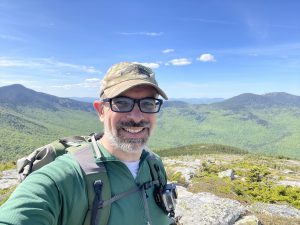
    Brian is President of Congregation Beth Israel in Bangor (Maine’s oldest synagogue), Treasurer for the Sisters in Arms Center in Augusta, a former paratrooper and transportation manager in the Maine Army National Guard, and a director of software development for a healthcare provider.  He’s also an author, musician, and now a rabbinical student!  He lives in Winterport, Maine with his wife, Leah, and their daughter, Nezzie.
  • Backcountry with Dogs

    Backcountry with Dogs

    Knowing Where to Go

    When I was stationed in Alaska, my ex-wife and I adopted a dog from the Anchorage shelter.  We named him D’Artagnan.  He was a Husky mix, former sled dog.  He was lovable, energetic, and old.

    I took him everywhere, with the exception of Denali National Park, where he was not allowed.  He came with, including on a flight into the Wrangell-St. Elias backcountry for a long, cross-country ramble.  He came with for shorter trips, like Crow Pass from Girdwood to Eagle River, where he proved problematic when it came to scaling ladders, even if he could handle complex glacial river crossings elsewhere.  When he passed away after a good life, I was broken-hearted.

    My Labrador Retriever, Max, went everywhere “good”.  When we were stationed in California, we really became experts at finding where backpacking with dogs is legal.  Yosemite and Sequoia / King’s Canyon were out, but the Emigrant Wilderness in Stanislaus National Forest was a fantastic, dog-friendly place to go.  Closer to our home in Monterey, the Los Padres National Forest offered excellent backcountry opportunities for people and canines.

    When Max and I moved back east, we made trips to the Adirondacks, to Shenandoah National Park, and places in Pennsylvania and the Catskills.

    Max has long-since passed.  Of our two dogs now, Bramble and Nanook, Bramble is the adventurous hiker.  Bramble enjoys rambles in Acadia National Park, so long as they don’t involve climbing ladders.  He loves Katahdin Woods and Waters National Monument as much as I do.  There are numerous public lands we visit and love here in Maine, both on foot and by canoe.

    There are a few epic trips I’ve made that necessitate leaving the dogs at home with my wife and kids, but for the most part, I try to tailor trips that include Bramble.  For one, they ease the loneliness of what is for me almost always a solitary endeavor.  Two, having a dog in your life imparts serious commitments.  You want them by your side at home, where we expect their domestic nature to kick in.  Why deny them the free-ranging experience of their lupine ancestors?

    It can feel, at times, like your destinations in the backcountry are limited by the presence of your dog.  I look at it this way…often you get lesser-travelled destinations that afford the one quality we all often look for—more general solitude.  The Emigrant Wilderness, for instance, never had the crowds of Yosemite, but arguably similar in terms of granite moonscapes, snowpack, and alpine meadows.

    I don’t whine about this.  People deserve backcountry spaces where dogs are not allowed, like Baxter State Park.  And let’s face it, there are more than enough people with dogs who don’t obey leash laws, or they don’t clean up after themselves, that we should understand tight regulation around their presence in the backcountry.  The bad apples continuously ruin this for us more than any other factor.

    Photo by Patrick Hendry on Unsplash

    The B.A.R.K. Principles

    • Bag your pet’s poop
    • Always leash your pet
    • Respect wildlife
    • Know where you can go.

    These are very simple rules to live by, but you’re trying to ensure that as you have a good time, you’re not ruining someone else’s good time.   You need to know your dog.  If it’s aggressive, if it’s a constant barker, if it’s not leash-trained…stay home.  These are not good fits for the wilderness.

    I learned my lesson with D’Artagnan in particular very quickly.  I left him off-leash on the Johnson Trail on the Kenai Peninsula in Alaska, and he ended up with a face full of porcupine quills.  The last thing you want is your dog agitating wildlife.  Some of it can hurt your dog, but more likely they can disturb vital animal habitats.  It’s also a matter of profound consideration for other hikers.  As much as I love dogs, nothing upsets me more than someone that thinks just because their dog is mostly under voice command and friendly, that I want them approaching me and sniffing me.

    Dog Gear

    Photo by Alexander Paul on Unsplash

    Your dog has needs in the backcountry, too.

    First and foremost, you need a bowl for your dog.  We filter our water on the eastern seaboard and other places because of giardia.  Did you know your dog can contract this parasitic protozoa as well?  Your dog is also vulnerable to leptospirosis, blue-green algae, cryptosporidium, and pythiosis…all things we filter water for our own drinking.  Bring water for your dog. Filter water for your dog.

    Since my dog refuses to sleep anywhere but right on top of me, I don’t bring him a dog sleeping bag or pad, except for during winter excursions.  I’ll augment with a fleece throw.

    You also should up your dog’s feeding amounts, because they, like you, will likely be burning more calories.  This means carrying extra weight.  My dog carries his own with his own little pannier set.

    For long canoe trips or gunkholing, I put my dogs in a life-vest.  I’m a strong swimmer, they’re strong swimmers, but they, like humans, get tired.  If I’m not trying to swim the English Channel, neither is my dog.  A lot of folks take for granted that as instinctual swimmers, there’s no issue here, but that is simply not true.  Make the investment.

  • Destination: Katahdin Woods & Waters Monument

    Destination: Katahdin Woods & Waters Monument

    Over the course of August 2020, I visited Katahdin Woods and Waters National Monument twice. This marvelous and remote stretch of land is a solitude-lover’s paradise. Winding streams, green-tunnel woodland paths, navigable rivers, backcountry ponds, and modest mountains all await the explorer.

    Katahdin Woods and Waters is also staggeringly remote. You can tackle the Park Loop Road with a front-wheel drive vehicle, but I wouldn’t recommend it. The road is dirt and gravel, and some trailheads, such as the one I will be writing about at Wassataquoik Stream, may not be passable in anything but a high-clearance four wheel-drive vehicle. Babyheads and blowdowns. My Jeep Wrangler handles things fairly well, but when I came up here in a Toyota RAV4, I was worried I didn’t have the clearance for some spots.

    Obey the 15MPH speed limit and you’ll be fine.

    Katahdin Loop Road

    The first time you come to the National Monument, it is my recommendation you take a trip around the 17-mile Katahdin Loop Road. Access from Maine Route 11 in Stacyville is via Swift Brook Road.

    There are numerous scenic views, ample short hiking opportunities. The closer you drive to dawn and dusk, the higher the likelihood that you see moose, foxes, porcupines, and the occasional bear.

    A view of Katahdin from a Loop Road overlook.
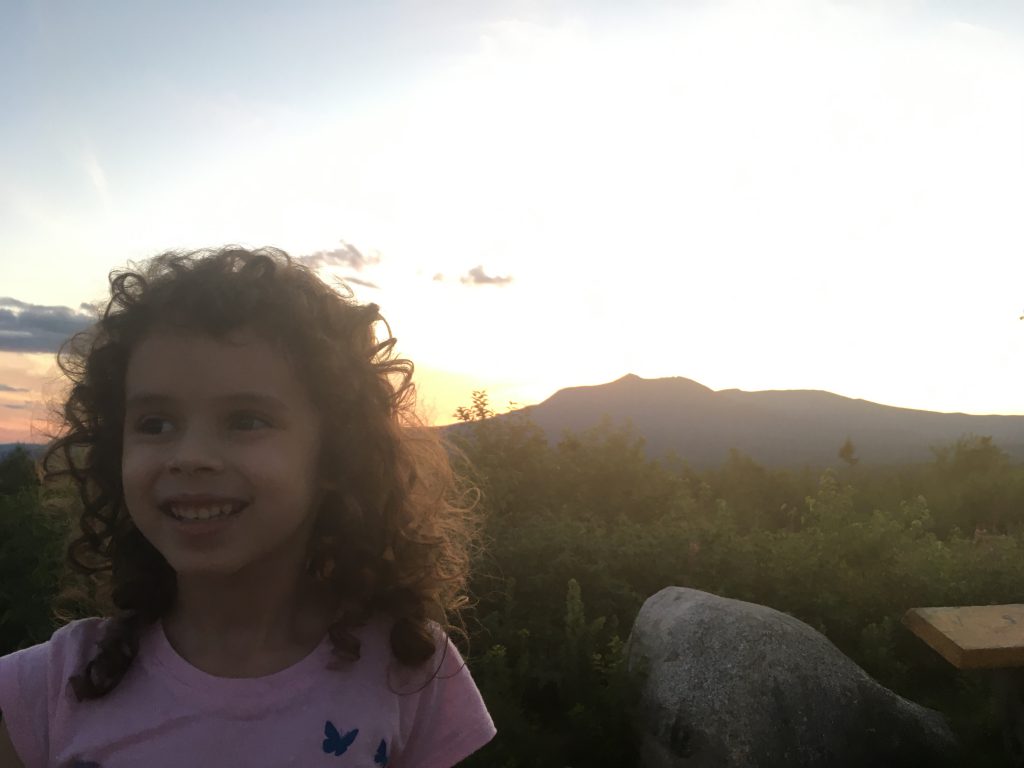
    The author’s daughter, Nezzie, enjoys an overlook of Mt. Katahdin and Millinocket Lake from the Park Loop Road.

    As it relates to your car’s suspension, it’s not an altogether pleasant drive. You must watch out for the occasional logging truck, but as far as isolation goes, it’s much less of a hassle than adjacent Baxter State Park.

    My Latest Hike

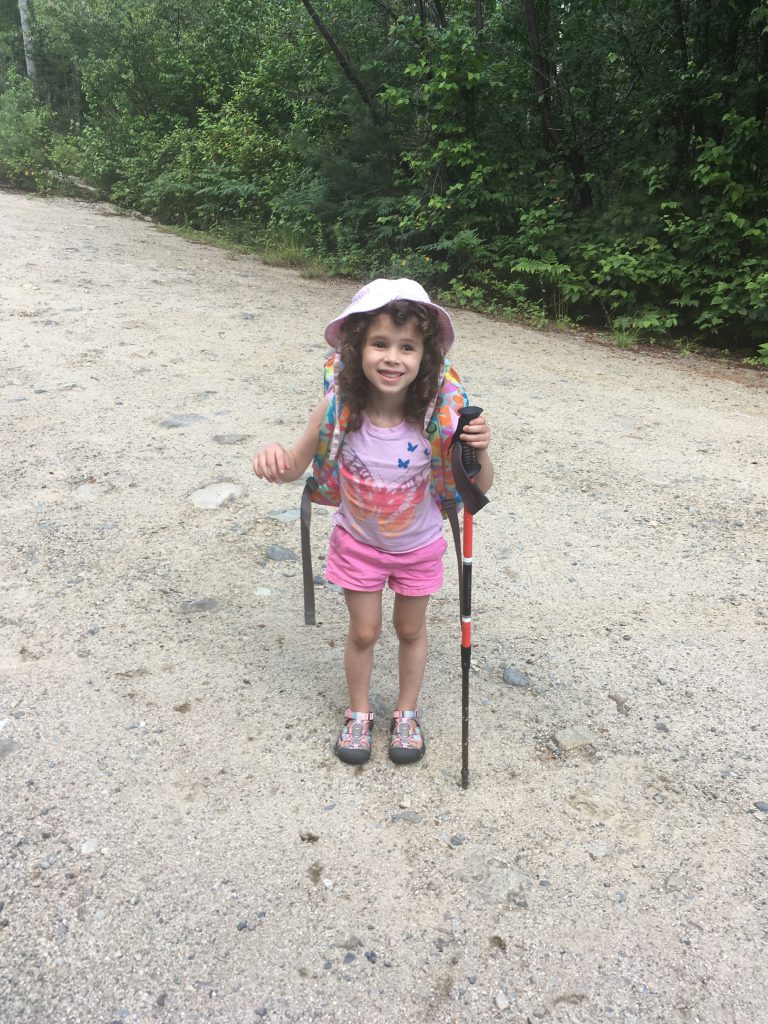
    My daughter, Nezzie, and I attempted to hike a portion of the International Appalachian Trail in the National Monument towards the beginning of August. We practiced for this by camping out on a remote portion of our own acreage in Winterport, Maine. She enjoyed fording Wassataquoik Stream.

    After the ford, the IAT follows the bank of the stream for a little while, before it pivots across some old beaver dams. It then heads up towards Deasey Mountain. Our intention was to summit Deasey and then Lunksoos Mountain, and then stay the night at Lunksoos Shelter.

    The author's daughter is ready for a backpacking trip, or so she thought.
    Nezzie is all geared up and ready to hike.

    Nezzie, unfortunately, was apprehensive about spending a night in such a remote location. I wasn’t going to force her. My older daughter, Amelia, went on her first 10-mile backpacking trip at the same age along the Appalachian Trail in Pennsylvania, but in fairness, starting from Route 501 is a far less isolating experience. We returned and simply enjoyed some shorter hikes and the road until night began to fall.

    I, however, was determined to return and at least overnight in the National Monument backcountry. I again followed the International Appalachian Trail towards Deasey Mountain, only this time turning on to the Ed Werler Trail to head towards the Big Sebois campsite.

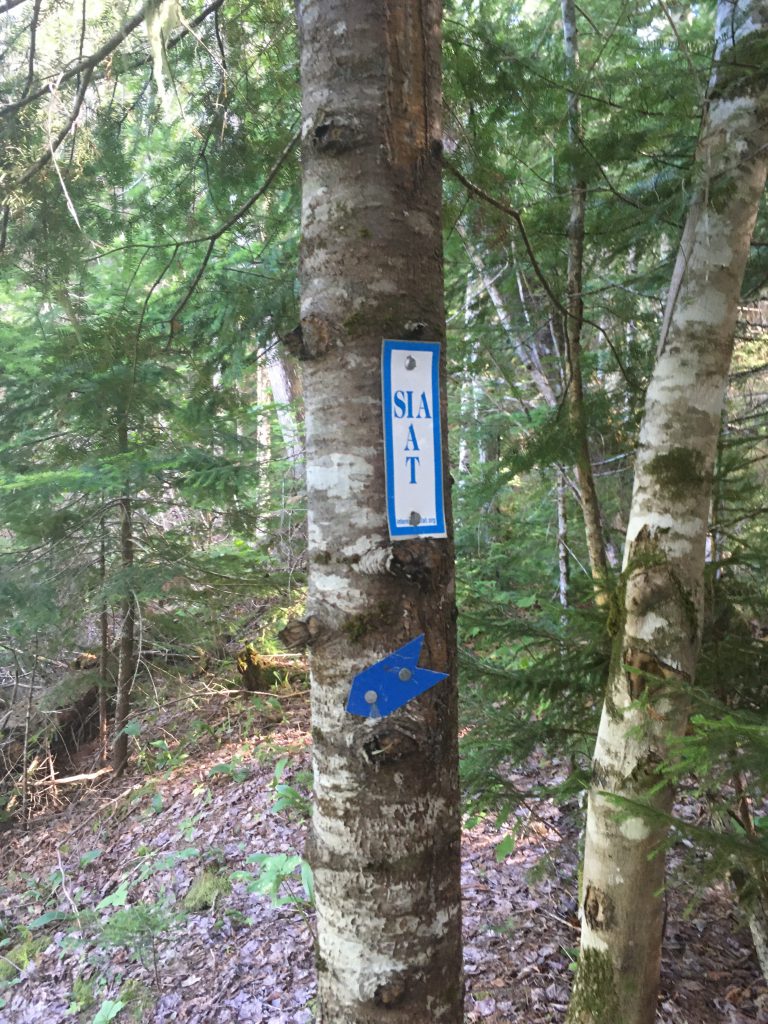
    An International Appalachian Trail Marking
    International Appalachian Trail Marker. The SIA stands for “Sentier International des Appalaches.” Since the trail travels through Quebec, even acronyms are mandated to be in French.

    The Ed Werler Trail

    The trail is named after the late, great Ed Werler, who for three years, from 1947 to 1950, was the fire watchman on Deasey Mountain. Ed passed away at the age of 102 in 2016. He and his wife, Mary Jane, lived in a small cabin, which you can still see in its deteriorated state along the trail to his old lookout booth on Deasey’s summit.

    Ed Werler wrote a great book about his time on Deasey and life as a Baxter State Park Ranger, titled “The Call of Katahdin”.

    The trail named in his honor, however, is a little less groovy. At just under a mile, it calls for better-than-average route-finding skills, and a patience for blowdowns. It’s a little bit of a relief when it intersects with the old East Branch Road. Still, if you attach the romance of a woodsman from another age coming up from the river to his mountaintop post, you can look past the challenge and enjoy the nostalgia for the age of wool, flannel, and cotton duck.

    From there, I proceeded generally south until the old road intersected with the trail to Big Sebois on the East Branch Penobscot.

    Serenity Now!

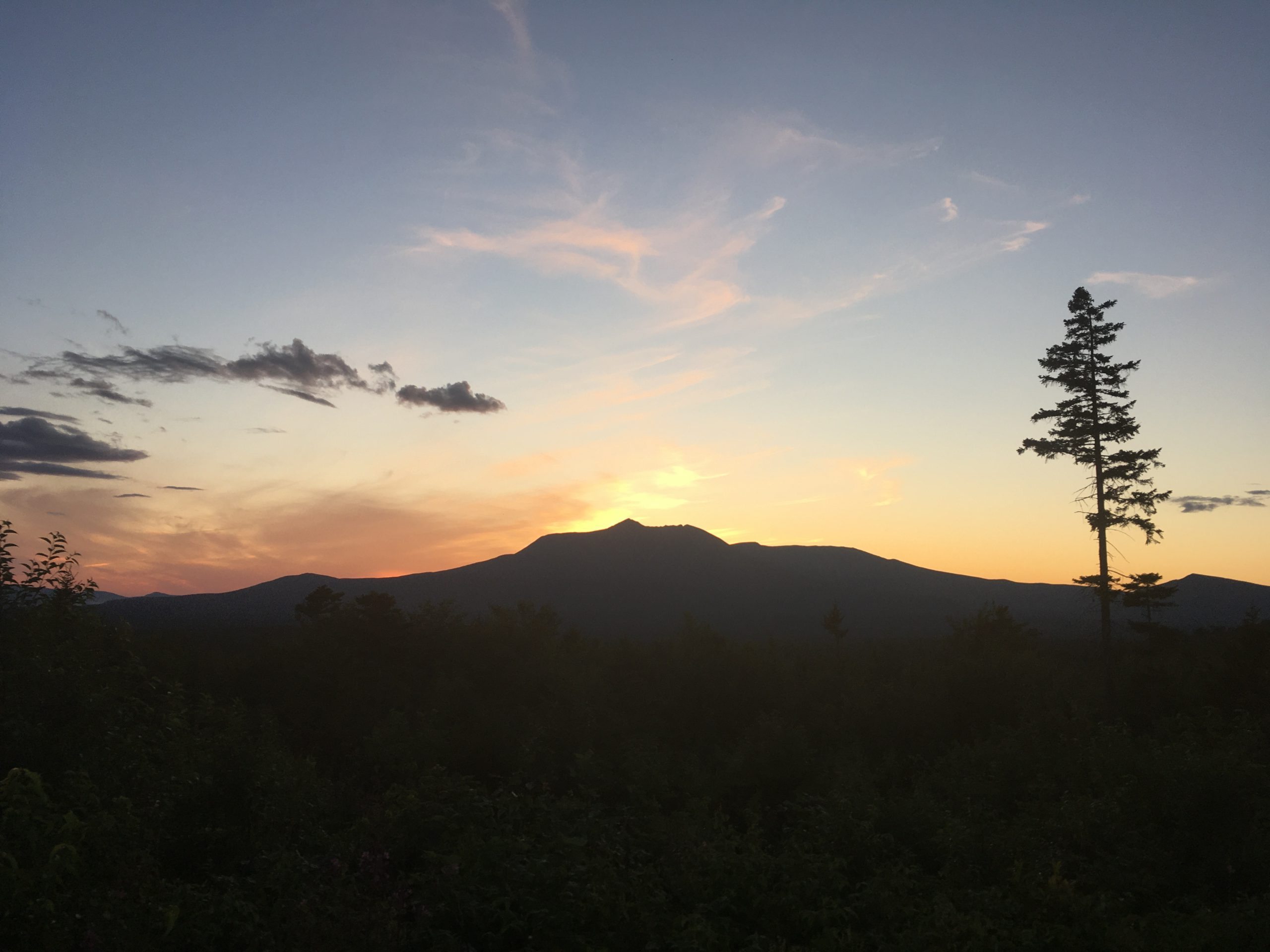
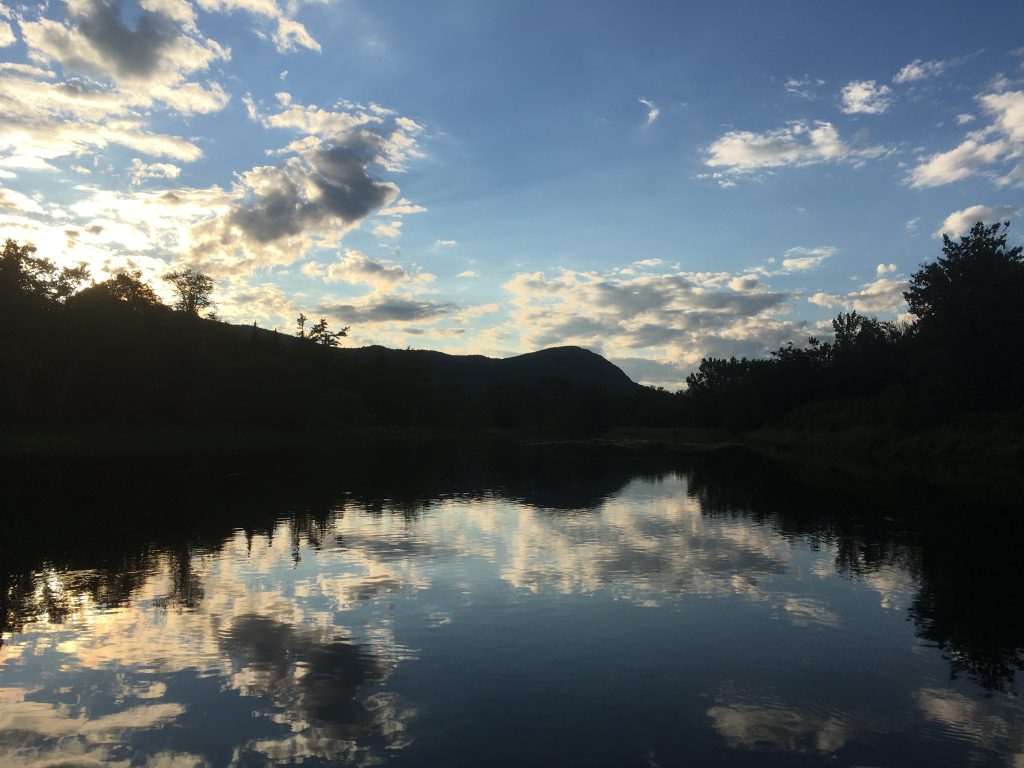
    The view from my campsite along the East Branch Penobscot as evening fell, with the silhouette of Lunksoos Mountain in background.

    The Big Sebois campsite is a lovely, well-maintained parcel overlooking a bend in the East Branch Penobscot River. It has a couple of picnic tables and some fire rings (permit required). It has level spaces for tenting, and ample trees for stringing up a hammock, as I did.

    I’ve stayed at this campsite before, though I paddled in during an extremely buggy July. Whereas on this trip I could comfortably recline in my hammock, my dog and I hastily retreated to the confines of our tent to escape the black flies. Choose your travel timing around black fly season wisely!

    Overnight, I heard a couple of crashes as neighboring beavers did their work. The placid waters occasionally were disturbed by the splash of a fish. What could have only been a moose noisily rambled through the water in the wee hours.

    The next day I walked out the way I came, reluctantly leaving this rare slice of tranquility behind.

    The Future of Katahdin Woods and Waters National Monument

    Many of us, since the current administration took office, have been worried about any executive order that would undo the National Monument designation. We’ve seen what happened to Bears Ears and other jewels.

    So far, it seems that the explicit rights of the Executive to designate a National Monument does not come with the implicit right to remove a designation.

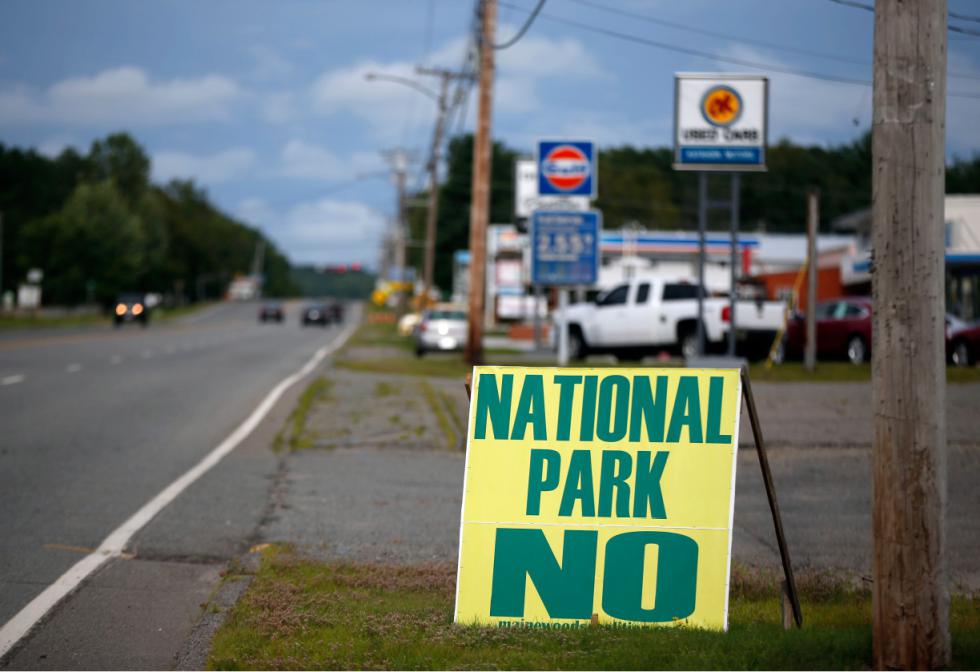
    Driving to the Monument, you do see a significant amount of opposition to it. “National Park NO!” signs line the roads, including those posted by private road owners. Maine’s previous governor went so far as to disallow road signs advertising the National Monument.

    Sign on road to Millinocket. (AP Photo/Robert F. Bukaty)

    Opposition has seemingly languished in recent years. Senator Angus King has been working towards increased funding year-to-year. I’ve often wondered, given how pivotal tourism is for coastal Maine, why rural locations are so opposed to an increase in visitation, however slight. If it weren’t for the generosity of Roxanne Quimby and her nonprofit founded for the purpose, the Katahdin Loop Road would likely not be graded, and what maintenance has taken place would not.

    It’s likely never going to be a federal funding priority, so I encourage visitors to donate to Friends of Katahdin Woods & Waters.

    There are some points of light, if you’ll intend the pun. The National Monument has been recognized as the first International Dark Sky Sanctuary on the east coast, and only the 12th time this designation has been given globally.

    Trip Video

    Further Reading

    Friends of Katahdin Woods and Waters

    National Park Service Website: Katahdin Woods and Waters National Monument

    If you want to paddle, here’s an old trip report from the East Branch of the Penobscot River that might inspire you.

  • Bear Bags vs. Bear Canisters

    Bear Bags vs. Bear Canisters

    After hiking portions of the PCT in Yosemite, the John Muir Trail, the eastern High Peaks in the Adirondacks, and Denali National Park, the notion of carrying a bear canister on long distance hikes doesn’t bother me.

    In trail forums on websites and social media, the debate usually centers on weight. There’s an orthodoxy of armchair quarterback ultra-light hikers that dreads the weight, when thousands of hikers somehow live through schlepping these things every year.

    My concern is I believe to be the correct one from a Jewish law perspective. Tsa’ar ba’alei hayim, to prevent the suffering of animals, demands that Jewish wilderness enthusiasts primarily consider the well-being of the creatures who inhabit the places we’re visiting before we consider anything else.

    If you are thru-hiking the Appalachian Trail, there are few trails anywhere that are as well-provisioned for our ursine friends. As I’m considering a shift to Vargo’s ExoTI frame backpacks for my looming long-distance hikes, the concept of a Bear Keg taking up pack space isn’t as onerous.

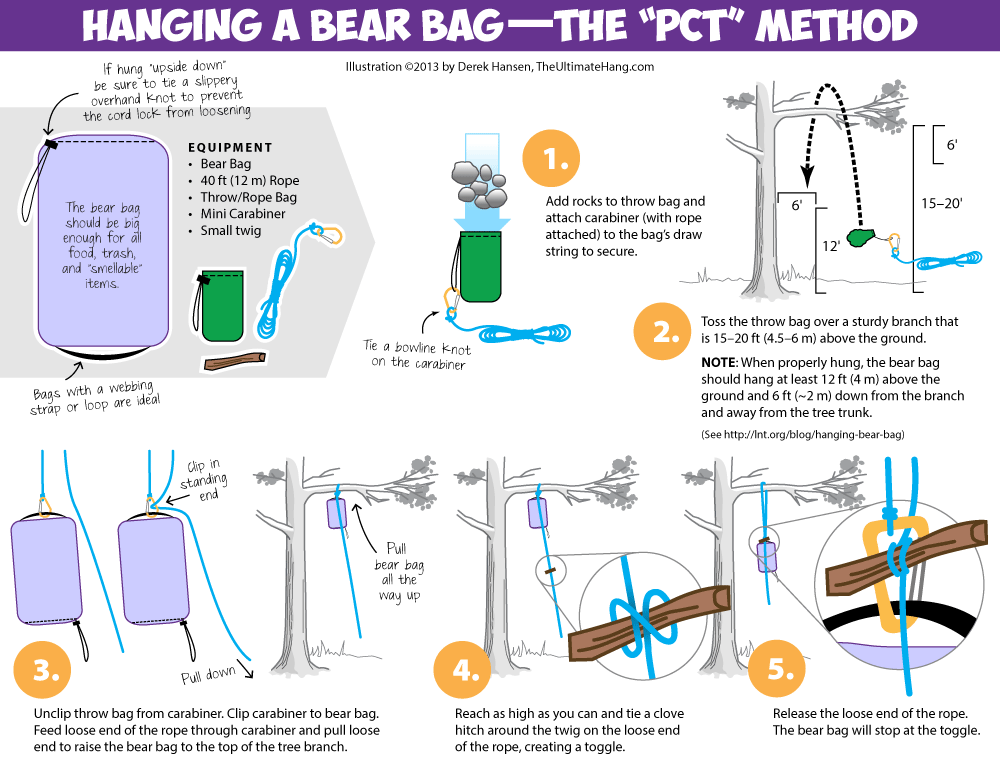
    Hanging a bear bag

    – Derek Hansen, TheUltimateHang.com

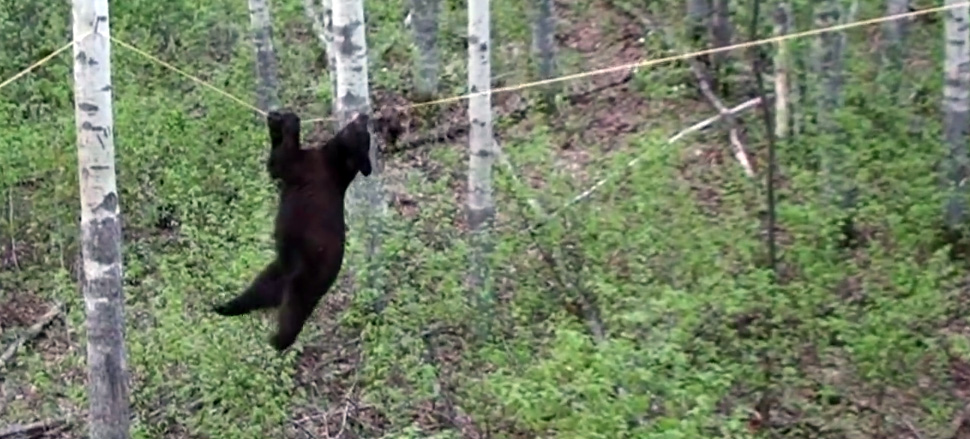
    When I have used a bear bag, I use the tried and true “Pacific Crest Trail” method. I’ve never had my bag compromised this way, though I have heard of people who did, either because they kept the bag too close to the limb, not far enough out on a limb, or a limb too close to the ground, etc.

    One of the concerns expressed to me by frum hikers is that hanging a bear bag and having access to food on Shabbos in the wilderness would present a problem.

    The melacha of koshair on Shabbos is specifically tying together two items through a firm knot. For that knot to be forbidden on Shabbos, it must be meant to be permanent. A clove hitch around a toggle is arguably not a permanent knot.

    And that’s the beauty of the PCT bear hang in particular for observant Jewish wilderness travelers; there’s no need to secure the free running end. This leaves you to ponder how you deal with appropriate distances for wilderness food storage from camp and your limited techum Shabbos!

    Kidding, you should be okay within a kilometer.

    Why you maybe shouldn’t bag

    Black bears are notoriously crafty. Your hanging picnic basket isn’t safe.

    Canisters are superior for bear safety

    “A fed bear is a dead bear.”

    This is what we must keep in mind when we make our decisions about wilderness bear country excursions. There are a variety of wilderness skills I’ve seen suffer from being in short supply. Map and compass skills are few and far between. Campsite selection is a recurring problem.

    But aside from violating the Leave No Trace ethic and taking up the time of search and rescue operators, poor bear hanging skills can literally cause the death of bears in their own habitat.

    This is unacceptable whatever your station in life. Our excursions are plenary, voluntary activities. You can stick to day hikes on safe trails if wilderness skills. A bear can only live in its place. It can’t go home to a house in the suburbs.

    So if you can’t practice a bear hang, or more importantly, you won’t practice a bear hang, please, please, please, invest in a bear-proof canister. The same goes, with less shame from myself and other wilderness ethicists, if you are hiking in places where bears are present but hanging opportunities are few and far between.

    On my first foray in Denali National Park in the 1990s, in addition to their backcountry quota system, they had the onerous requirement that you rent one of their bear canisters. As an East Coast kid, this was new and novel to me, but based off grizzly encounters I had in the field in Alaska as an Army paratrooper, I realized there was sound reason for these practices.

    Sure, it was heavy and ungainly, but it was, honestly, far less hassle than a bear bag. I’ve had bears bat them about like little soccer balls, but the food remained secure, and the bears presumably remain alive.

    And bonus – bear canisters are Shabbos-friendly.

    Do your research

    I ultimately settled on Counter Assault’s Bear Keg product, after losing a black rental unit in the Adirondack High Peaks. Bear Kegs run a little bit heavy, but their bright yellow with a reflective stripe around the center make them far easier to spot if a bruin commits to some mayhem.

    Famously, an Adirondack black bear purloined food from the Bear Vault product about ten years ago, and it’s my understanding that they are still not permitted in the backcountry there as a result.

    In any case, you’ll want to check the requirements of the managing agencies where you want to travel along with your own brand research.

  • 2020 Allergy Season:  What Backpackers Should Know

    2020 Allergy Season: What Backpackers Should Know

    Not to advance stereotypes about Jewish health neurosis, but bubbie wants you to take care of yourself out there, you know?

    According to AccuWeather we’re on track for a pretty severe allergy season.

    We talked to an immunologist friend and sought some advice that we can share about the Pollen Apocalypse and how you can still enjoy time outdoors.

    Drugs

    Now that I’m out of the military and mandatory drug testing, I like saying, “drugs.” But for me, and especially my youngest daughter, I couldn’t survive without Claritin or other antihistamines during allergy season.

    Go Up!

    In Maine, we have a good amount of “above treeline” hiking, but we’re also close to it in New Hampshire. Pollen is heavy in the air, and above tree line, most of it will end up going down the slopes, leaving the exposed ridgelines relatively pollen free.

    Stay Inside, or Hike During/After Rain

    This has the biggest “boo, hiss” factor of all the advice. Even inside pollen season, there are still some days that are better than others. Pay attention to your local weather forecasts, air quality action days, and try to time your outing to when it’s most conducive to healthy respiration.

    The other option is to look for rainy days. This is a downer or a deal-breaker for many people, but rain will wet pollen down or wash it off of trees.

    Clean Yourself

    During allergy season last year, I started getting a jump start on rebuilding our woodpile for the coming winter. I ended up going to bed every night with a massive headache and clogged sinuses.

    I’m a “morning shower” guy, so I was going to bed with a lot of pollen in my hair (even with my yarmulke), and subsequently was rolling around in it. Now, during pollen season, I shower after working outside.

    The same applies to camping. It’s so easy to bring pollen with you into your tent, which as far as enclosed spaces go, can be like an echo chamber for allergens.

    Camping Choices

    During high-pollen times, camping downwind of forests or fields of wildflowers can be a great choice. But if you live in an area with dramatic windshifts, this isn’t always all that useful.

    Camping near a river, lake, or pond can be helpful, as they attract and hold pollen, but you must be careful not to run afoul of the wilderness ethic and responsible practices.

    Don’t Underestimate Allergies and their Ruinous Impact

    Aside from the feeling that it never stopped raining, the other factor that almost drove me off the Appalachian Trail during my first thru-hike were the high-pollen count days.

    I wasn’t subject to frequent sneezing, but my eyes felt like they were on fire, forcing me to abandon my carefully-tended contact lenses (which was a mistake story for another day) and wear my super-ugly glasses for months. I had non-stop headaches, and because I packed all wrong to begin with, and I was dirt-poor, there was no medicinal relief. In what would become the story of the majority of my adult life, I just soldiered through.

    Sometimes we take our health for granted, until we’re reduced to our rawest forms in the wilderness. It’s then you realize that the medicine cabinet and air filters don’t fit in your pack. It’s good to consider allergies in any of your seasonal hiking choices.

  • Cold Weather Backpacking

    Cold Weather Backpacking

    And with snow accumulating to around an inch, it was suddenly winter in Maine.

    I watched with envy this year as people concluded their Appalachian Trail thru-hikes, some as early as August, some as late as October. It strikes me just how quickly summer went this weekend. I had two major hikes over the summer myself – a long weekend trip out Gulf Hagas, and a long weekend trip to the Bigelows.

    Both trips were along the Appalachian Trail.

    I also field tested gear on our voluminous acreage. The lovely thing about our woodland home, which we have named Eitz Kar, is that we have plenty of wilderness right outside our back door. It’s also easier to camp with my pre-schooler if we don’t have to drive several hours only to turn around.

    There are many good books about winter backpacking, but I’d like to highlight some important notes.

    Winter Gear is Heavy

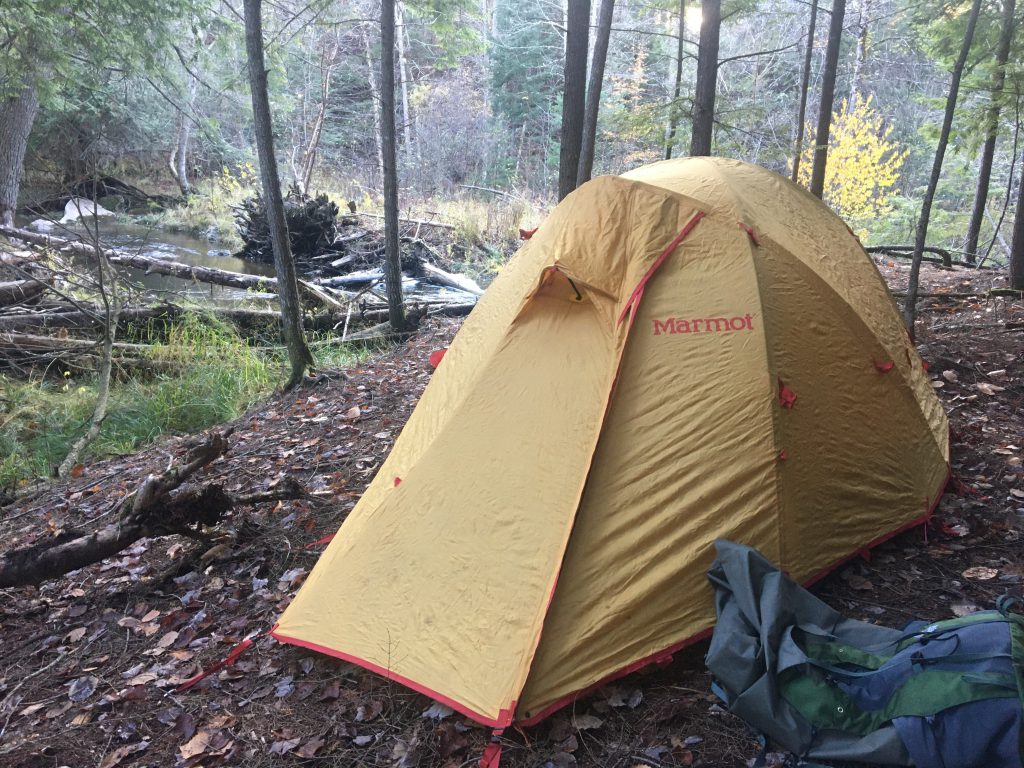
    At 10 lbs, my venerable Marmot Sanctum, which has been at altitude in the Chugach, Alaska, and Brooks Ranges, is a bear to carry these days.

    If you’re just getting into cold weather camping, the first thing to know is that it’s heavy. There’s not really a margin for ultralight here. And take this from me, a former Arctic Paratrooper, you don’t want to be calculating your base weight in the winter months, especially if you live in the Northeast or travel to the mountainous regions out west. That cuben fiber tarp you evangelize us about for your summer AT thru-hike doesn’t have a place in the winter.

    It doesn’t mean you have to go overboard with super heavy stuff. There are tarp tents perfectly suitable for cold-weather season use.

    I haven’t been able to empirically qualify this with stats yet, but I do wonder how many earnest AT thru-hikers come off the trail with a February or March start because the weather is too much for them. Given the number of folks who toss in the towel, I’d wager it’s a good bit. Even with bounce boxes and changing out sleeping bags, it’s hard to get out of the bag on a cold weather day and get moving.

    Trust me, after years of field training exercises in proximity to or north of the Arctic Circle, I know.

    Winter is a Mind-Killer

    Last winter, Amelia and I scaled Bald Rock Mountain in Camden Hills State Park so we could take in a gorgeous, albeit freezing, Penobscot Bay sunrise.

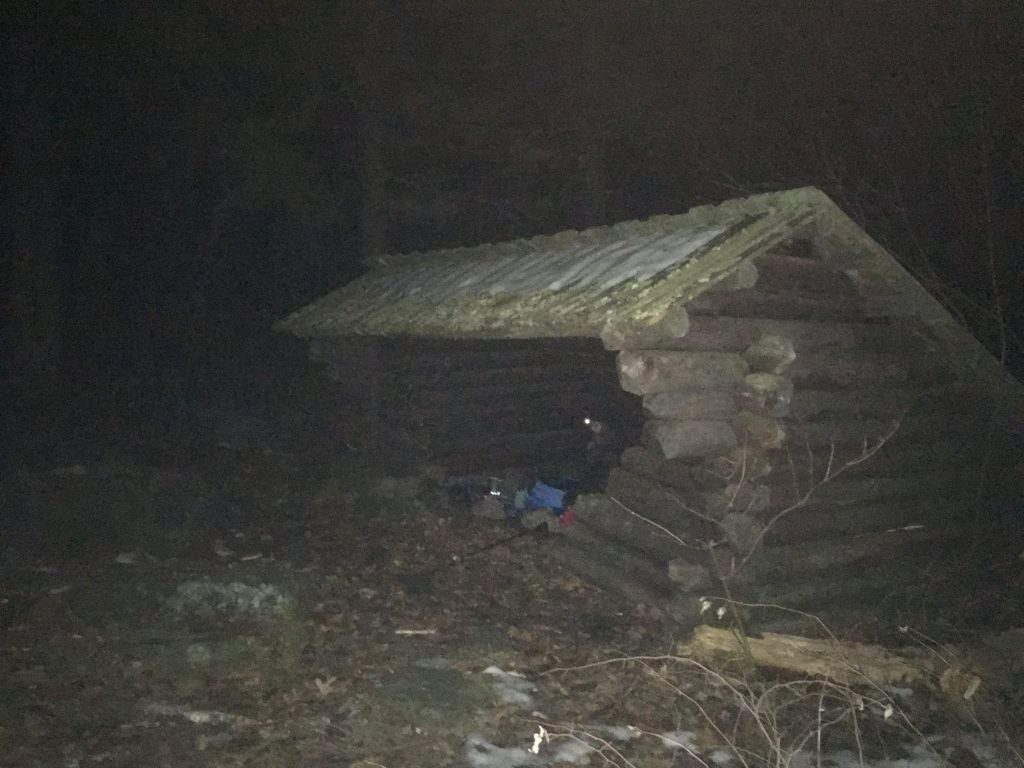
    One of the shelters atop Bald Rock Mountain

    It was not disappointing. We spent a chilly night in the Adirondack shelters atop the peak, and woke up to warm coffee and tea as we watched the sun crest the eastern horizon.

    It was spectacular, but our feet and fingers were numb by the time we made it back to the car. We weren’t underprepared, but it is difficult to find the motivation to function in the morning hours.

    In bear country, it may not be an option, but having your stove prepped so you can slightly pop out of your sleeping bag in the morning and get the water boiling is a good way to get started. This is better suited for the parts of the season where bears are hibernating. End of winter, early spring hikes when it is still cold, especially on the AT, may not be an appropriate time of year to do this, as the bears may be stirring.

    How to Start a Hike

    I wrestle with my daughter on this, too. After 25 years of road marching in the Army, I can tell you, always start the hike slightly chilled. You will heat up as you go along. My rule is that if my teeth are chattering at the start of the hike, I’m doing the right thing.

    I’m not going to bore you with a redundant lecture about no cotton, synthetic wicking layers, or layering in general. If you’re a hiker that reads this sort of article, you’ve more than likely already digested four of those.

    If there’s snow on the ground, or even if it’s cold enough that the ground will be hard, start at a slower pace than you would over the summer or spring. You’re going to burn calories at a faster rate, because you’re probably carrying more and heavier gear. Where you might want to do a higher mileage day in another season, this is the time to take it slower (exception being ski touring).

    Bring More Fuel, More Food, More Water

    …and don’t ever just eat snow. You expend more water melting it in your mouth than you do bringing it in.

    As we mentioned, cold weather hiking is harder work. Consider a stove with fuel that is performant in cold weather. Consider that you may need to stop and replenish water by melting it, if sources are frozen over.

    You need to take in more calories. Read the damn Nutrition Facts. Many popular hiking foods provide more sodium than they do carbohydrates. Don’t incur a cold weather injury because you don’t bring enough of the right kinds of food.

    Little Tips I Wish I Learned Before I Sustained Frostbite

    You can make a vapor barrier for your boots out of bread bags. This ghetto fabulous trip was one that I failed to internalize when my parents would do this for me growing up in Pennsylvania.

    10 hour handwarmers are great, and relatively lightweight means to keep your fingers and toes from losing warmth. As much as I love winter, this has always been my struggle.

    Army surplus climbing skins will work with almost every model of ski.

    You don’t have to spend $40 on replacement MSR Snowshoe straps if you have parachute cord and an imagination.

    A children’s sled can easily be converted into a halfway decent pulk for winter camping. I’ll be doing a video about this in Katahdin Woods and Waters this winter.

    Winter Wonderland

    Winter right out my back door.

    I love winter camping more than summer camping. I love reading Jack London short stories, particularly “The White Silence”, by a fire in the Maine woods.

    There’s a crushing sense of isolation and self-sufficiency with a tremendous amount of romance buried therein. When you tap into that, you discover so much about yourself and your own capabilities.

  • Sukkot 5780

    Sukkot 5780

    An Excellent Holiday Entrypoint for Wilderness Backpacking, and to Learn about the Holiday

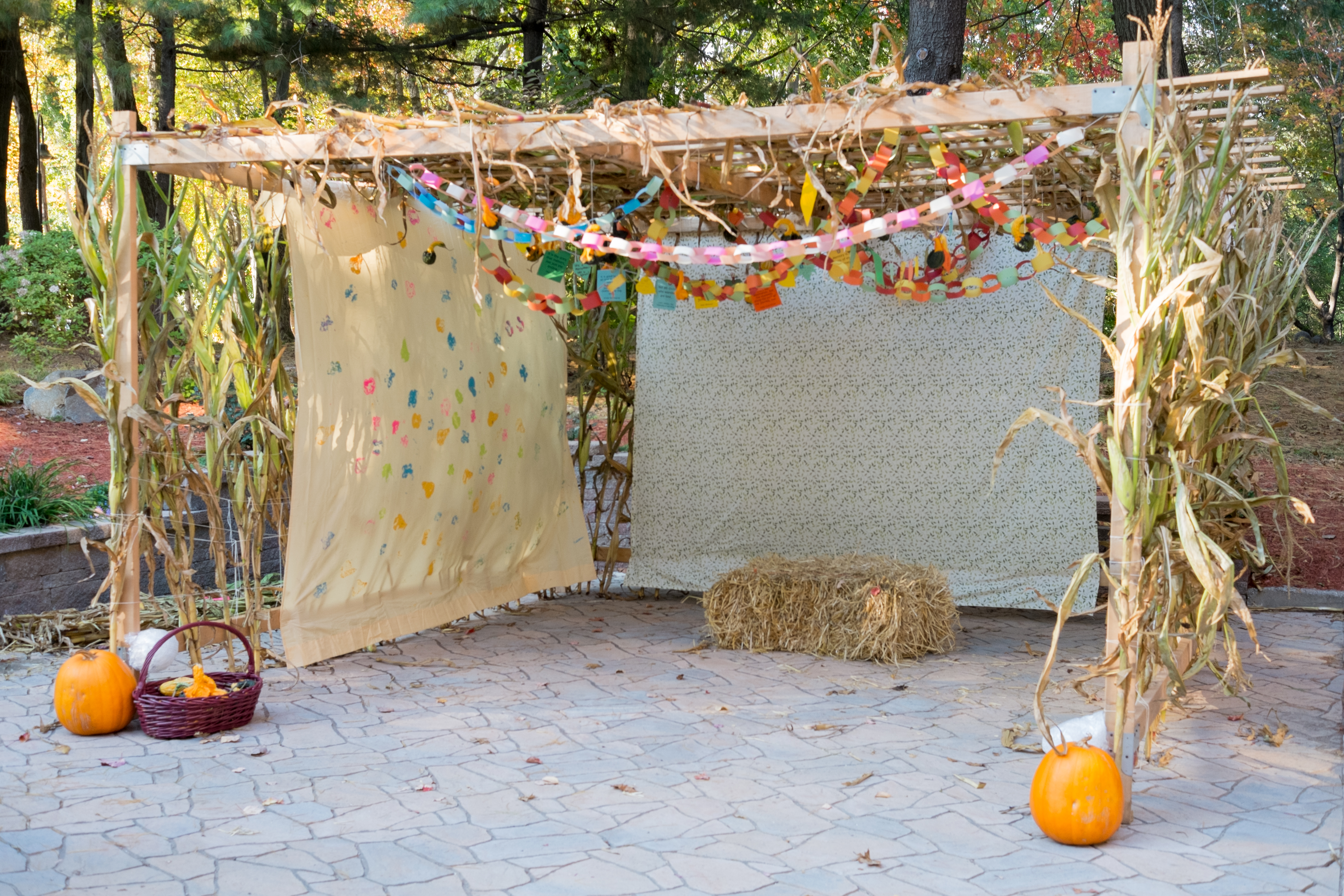
    You shall dwell in booths seven days; all citizens of Israel shall dwell in booths; so that your generations may know that I made the children of Israel to dwell in booths, when I brought them out of the land of Egypt.

    Leviticus 23:42-43

    I was backpacking in upstate New York during Sukkot one year, somewhere in the High Peaks, when I was hit with a hail storm. I was at least several miles from any of the shelters, so I hastily put my poncho tarp up using my hiking poles and some bungee cords, and listened as the chunks of ice bounced off of the taut sheet of nylon.

    There’s a chronology to the treatment of Sukkot in Torah, the Talmud, the Geonim and Rishonim, and Acharonim through to today, which echoes the approach to all of Jewish life and wilderness experiences.

    We start with just doing it. The concept of a pilgrimage festival and sleeping in a sukkah celebrates both the harvest and as a reminder of where we come from.

    It’s not indistinct from the “call of the outdoors.” We get outside because we want to remember, if that’s the right word, something primal.

    Then, in the Talmud, we get the treatment of how to build a sukkah, and what makes a sukkah “correct” under Jewish law, how we sleep in it, how we take our meals in it, and so forth.

    This is where our relationship to the outdoors matures. Maybe we’ve been carrying too-heavy tents and sleeping bags, cooking our food over fires instead of stoves. Like learning to build a proper sukkah, we’re at this point transitioning to lighter gear and less impactful outdoor practices.

    Finally, we’re left with “what does this mean?” What are the esoteric, moral, and spiritual dimensions of Sukkot? Why do we welcome the ushpizin?

    Will there be land for me to hike on in a decade or more? What can I do to preserve these treasures I backpack through? Why do I keep coming back to the woods?

    Sukkot is a holiday that captures gratitude, providence, the payoff of hard labor, and finally, the Jew’s visceral relationship to his or her history. An outdoor Jew then—especially during Sukkot—is sharing a common space with the ancestor who slept beneath the stars for 40 years in the wilderness.

  • Backpacking with Children

    Backpacking with Children

    I was reading a piece by Rabbi Jonathan Sacks about priorities as related to Parsha Matot-Masei, where he cites Rashi’s commentary on Numbers 32:16. Moshe reorders the priorities in the request of the tribes of Reuben and Gad to stay in land on the east side of the Jordan that was good for raising cattle.

    נבנה למקננו פה. חָסִים הָיוּ עַל מָמוֹנָם יוֹתֵר מִבְּנֵיהֶם וּבְנוֹתֵיהֶם, שֶׁהִקְדִּימוּ מִקְנֵיהֶם לְטַפָּם. אָמַר לָהֶם מֹשֶׁה “לֹא כֵן, עֲשׂוּ הָעִקָּר עִקָּר וְהַטָּפֵל טָפֵל, בְּנוּ לָכֶם תְּחִלָּה עָרִים לְטַפְּכֶם וְאַחַר כֵּן גְּדֵרוֹת לְצֹאנְכֶם” (תנחומא):
    נבנה למקננו פה WE WILL BUILD [SHEEP FOLDS] FOR OUR CATTLE HERE — They paid more regard to their property than to their sons and daughters, because they mentioned their cattle before their children. Moses said to them, “Not so! Make the chief thing the chief thing and what is subordinate subordinate. First build cities for your little ones and afterwards enclosures for your flocks” (cf. v. 24) (Midrash Tanchuma, Matot 7).

    Rashi’s commentary on Bamidbar 32:16.

    “First, build cities for your little ones.”

    For most of my adult life, backpacking has been a solitary affair. However, when my now teenager entered my life, it was amazing how impatient I was for the moment that we could hit the trails together. Indeed, Amelia’s earliest backpacking trips were along the Appalachian Trail in Pennsylvania, followed by forays into the High Peaks region of the Adirondacks.

    Amelia on a brisk December backpacking trip to Bald Rock Mountain in Camden Hills State Park near Lincolnville, Maine.

    When you have children, it seems to me that building wilderness experiences for them early and often is the correct Jewish outdoors take on things.

    Amelia still occasionally joins me for trips to the Maine woods, usually via canoe. We worry about the strain of backpacking after her Marfan Syndrome diagnosis, so the “Daddy Death Marches” as she calls them have diminished.

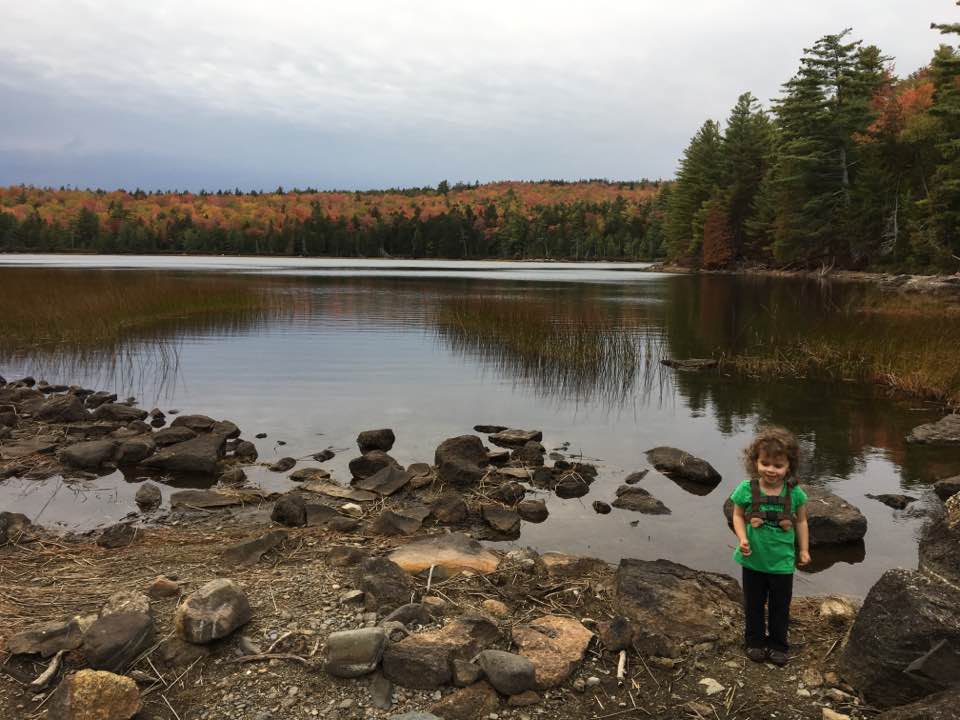
    Our four year old, Nezzie, is eager to hit the trails and sleep in a hammock or tent. I tried before, when she was still three, for a foliage-rich trip to a lake in Amherst Community Forest. She wasn’t ready to sleep overnight in a tent relatively distant from home at that point, but she loved the hike, and she loved playing on the granite slabs common to Maine inland water.

    Plan Ahead

    Over the summer, it’s tempting to just throw some gear in the car and head for the hills, but with children, you just can’t do that, especially younger children.

    Nezzie is a profoundly picky eater, and ensuring we have the right food on hand so that she’ll take in enough calories to push through even a small hike is important. She’s also an extreme creature of habit. We have a morning ritual of pouring her a cup of grape juice mixed with water, which she drinks usually while cuddling Leah or I. I simply have to provision for those things.

    Our nighttime ritual is also an important consideration. We already live in the woods, so the nighttime noises are not distressing to my little one. They may be for citified children.

    It’s important to consider what mileage is practical for little legs. For some, it may be prudent to check with a doctor. We routinely ask, during our yearly visits to Johns Hopkins with Amelia, what level of exertion is medically appropriate for her.

    Also like me, if you’re concerned about teaching your children what is Jewishly appropriate with respect to maintaining observance in the outdoors, planning to add to your adventure some knowledge sharing about simple rituals like hand washing can be really rewarding.

    Small Steps

    For us, indoctrinating Nezzie to hiking has been easy. We have a 12-acre, wooded lot with a plurality of hiking trails. We also have the capability of doing a little bit of a bushwhack. Our lot is wild, with owls, fishers, and a brook teeming with trout and sometimes spawning salmon (though rarely). We frequently see turkeys, deer, foxes, grouse, porcupines, and the occasional bear.

    What kid doesn’t love carrying a backpack? At most ages, I’ve done the heavy lifting, but I’ve always encouraged my children to carry at least their personal items and clothes. As they get older and more sturdy, they can carry their own sleeping bags, as well. They always have a snack and a water bottle.

    We also don’t go at a huge pace. Whatever mileage we do, especially with a pre-schooler, I let Nezzie drive the train. If she wants to stop and literally smell the roses, that happens. If she wants to chase a bug, or take in a view, we stop. It’s also a good time to teach your children an age-appropriate take on the Leave No Trace ethic.

    “I’m Bored”

    I revisit planning for this. As much as I hate to do it, I’ve packed Nezzie’s Amazon Kindle to keep her entertained, or to help her fall asleep. I get the stinkeye from many others about this, but just as we like to say HYOH (Hike Your Own Hike), I like to say, MYOFB. You get the drift.

    But I don’t rely heavily on technology. I bring fun games, or we go for mini hikes. When Amelia and I put-in to paddle to campsites on the First Debsconeag Lake here in Maine, we also include in our itinerary a jaunt to the northern side of the lake, to check out the Ice Cave Trail. When we were in the Adirondacks, we spent a lot of time just wading in the water near Marcy Dam, or Lake Colden, or maybe bagging a peak or two on the side.

    One tradition of mine is to bring a worn copy of Jack London’s short stories from the North, and read those by campfire or lamplight (depending on fire permits and regulation). This was a tradition I started on cold snowshoe journeys in the Army in Alaska, and something that has stuck with me, and annoyed my children, to this day.

    I admit, now that I’m a father of 17 years (the age of my oldest), the outdoors have transitioned from an important source of adventure and reflection to be something of incredible value in our family lifestyle. When my children watch me leave the tent at sunrise to daven, I can help them connect the dots between what we learn in shul about Creation and a Creator, and our visceral relationship to that as realized in nature.

  • Lag B’Omer:  The Perfect Wilderness Holiday

    Lag B’Omer: The Perfect Wilderness Holiday

    Let’s face it, most of the fun parts of the Lag B’Omer holiday are rooted in the aggagic stories concerning the origin of Kabbalah. If, like me, Kabbalah plays little to no authentic role in your Jewish observance, you may struggle with the implications behind a bonfire.

    But who doesn’t like a bonfire? Here in Maine, with May temperatures not rising above the 50s/60s, it’s a lovely way to spend an evening, especially in the period of quasi-mourning that marks the Omer.

    What is the Omer?

    This is the 49-day period between the eve of the second night of Pesach and Shavuos. We have a ritualistic count of the days in our liturgy during this time. In the Torah, it’s defined as the seven weeks the Israelites would count between Pesach and bringing a grain offering to the Temple in Jerusalem. Shavuos was one of the three pilgrimage holidays prescribed in Torah. Later, it became representative of the giving of Torah on Mount Sinai seven weeks after leaving Egypt.

    Today, we have less emphasis on the grain harvest, and more on some post-Biblical events leading up to Shavuos. The Omer are a period of quasi-mourning. Observant Jews avoid haircuts, shaving, listening to instrumental music, weddings, parties, and dancing. We do this in memory of the students of Rabbi Akiva, who were either killed during the Bar Kochba uprising or a plague (sources vary). In either case, they were killed in retribution by the Divine for being mean to each other.

    Enter Lag B’Omer

    The story goes that on the 33rd day of the Omer, the plague afflicting the students of Rabbi Akiva was lifted. The first specific mention of the day as having any significance came in the 12th century, and became associated with the Akiva story by the Catalonian Talmudist HaMeiri around that time.

    If you believe in the origin story of the Zohar, the follow-on tradition is that one of the 5 surviving students of Rabbi Akiva, Rabbi Shimon bar Yochai, purportedly authored the principle source of Kabbalah. Many Jews, like myself, who believe that it was authored by Moses de Leon in 13th century Spain, consider Zohar, and subsequently Kabbalah, to be apocryphal.

    But many haredi and chassidim, as well as Jews who are not traditionally observant, incorporate it either as a vital component of Jewish learning, or take components where they find meaning and incorporate them into modern liturgy.

    So, to honor Rabbi Shimon bar Yochai, people gather throughout the 33rd day of the Omer to light bonfires in honor of the “spiritual light” gifted to the Jewish people with his esoteric teachings.

    One of the Best Outdoor Observances

    Back in the early 2000s, when I thru-hiked the Northville-Placid Trail, I did so during the Omer and overlapped Lag B’Omer. For any thru-hiker who is observant, backpacking generally falls in line with the general sense of mourning. You don’t shave, you don’t get haircuts…you likely smell really bad. On Lag B’Omer, you can stage that day as a reprieve from this, plus couple a lovely campfire (as regulation and good sense permit) with the day.

    There was nothing more edifying than a fire in the Adirondacks with Jewish implications.

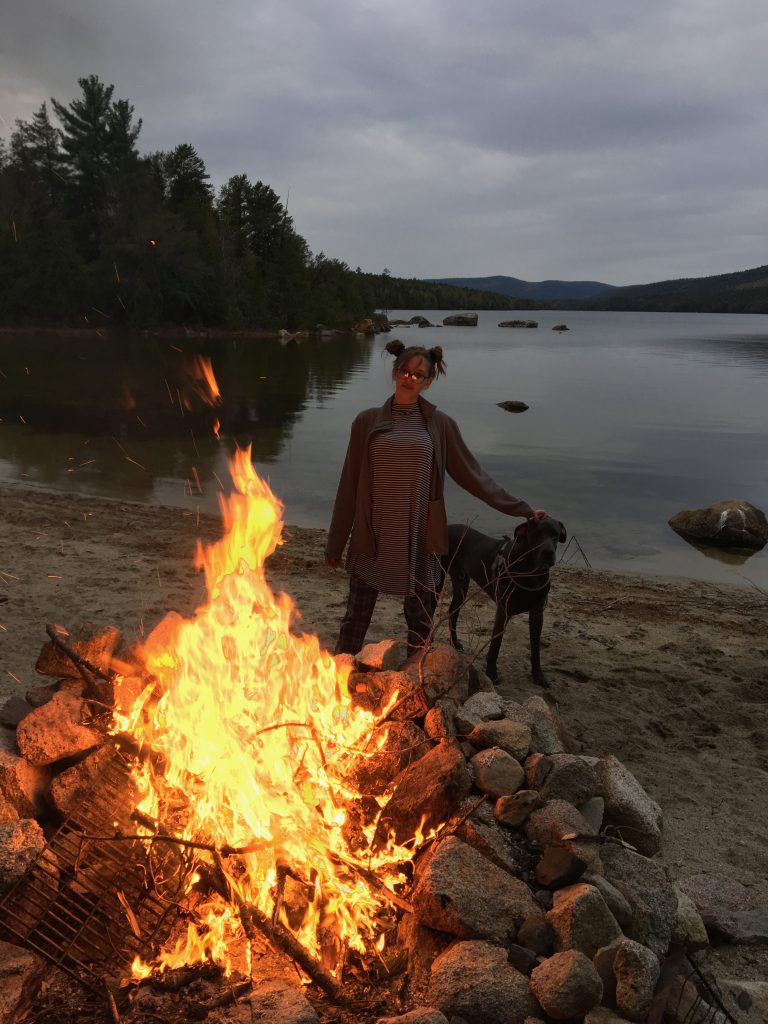
    My wife and I, though maintaining an observant household, are not invested in the Kabbalah. We both enjoy the works of Aryeh Kaplan (Leah wrote a thesis on Jewish meditation for her undergraduate minor), but we don’t frame observances around Kabbalistic sources. And yet, on our wooded acreage in Maine (named Eitz Kar), we still host friends from the Bangor Jewish community for a Lag B’Omer bonfire.

    I know from my many days on the trail, all over the world, that few things build communities, even temporary ones, better than a group of people surrounding a fire. The boundary of such a community is the extent to which the flickering flames abate the encroaching darkness.

    The Best Places to Spend Lag B’Omer in the Wilderness

    I’ve spent an enormous amount of time in the wilderness over Lag B’Omer. Here are some of my favorites.

    Assateague Island National Seashore – Maryland and Virginia

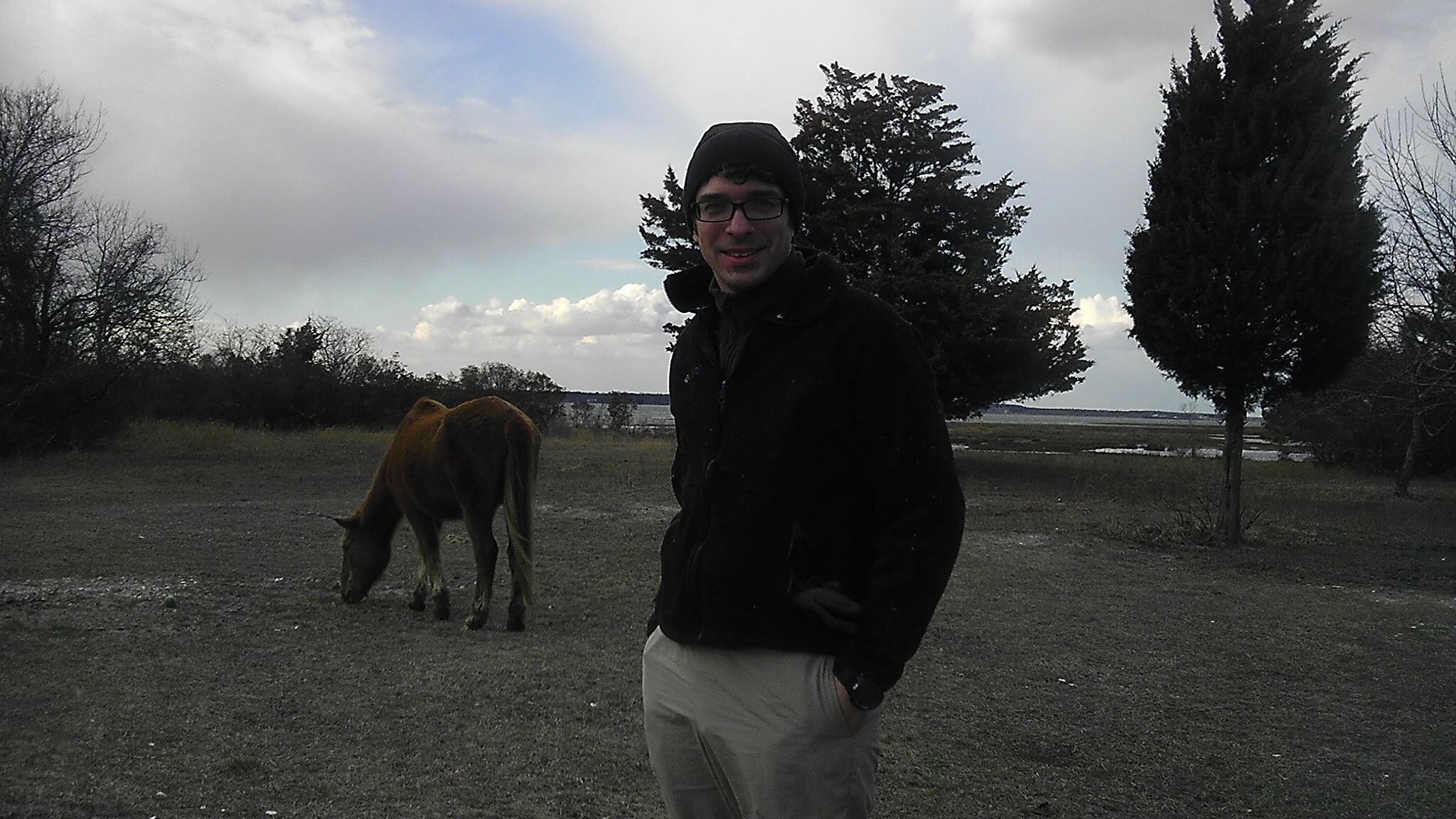
    Wild horses can’t drag me away from Assateague

    A barrier island off the coast of Maryland and Virginia, known for its wild ponies, is a wonderful setting for an overnight Lag B’Omer experience. Beachside and bayside campsites offer backpackers a stroll down the shore coupled with an amazing overnight experience rare along the East Coast.

    Trips during the Omer may not be possible, especially from the Virginia end, because of nesting shorebirds.

    https://www.nps.gov/asis/index.htm

    Debsconeag Lakes Wilderness – Maine

    My Daughter, Amelia, and our blue Dane, Atticus Blue Radley, in DLWA

    Every year at least once since moving to Maine, my daughter and I have canoed from the launch on the Debsconeag Deadwater to backcountry campsites on First Debsconeag Lake, or via portage, Second Debsconeag Lake.

    Off of First Debsconeag Lake, there is a really cool trail to the “Ice Cave,” a little cave where the temperatures stay low enough to keep snow year-round. I personally prefer to make the portage to the second lake, as on long weekends over the summer, First Debsconeag Lake campsites can be inundated with motor-based watercraft campers who bring generators and can be very disruptive to an authentic wilderness experience.

    https://www.nature.org/en-us/get-involved/how-to-help/places-we-protect/debsconeag-lakes-wilderness-area/

    Adirondack High Peaks

    A shelter in the High Peaks

    Fires are a no-go, but the Adirondack High Peaks are a great place to go just generally. Amelia and I have started many a May or June hike from Heart Lake and had an amazing time. Just like Maine, black flies may make you regret your choice, but a view from Mt. Marcy or a Wolfjaw may change your mind.

    The Emigrant Wilderness – California

    This wilderness, which is real Muir/Adams country, is one of the best open secrets in the Sierras. Adjacent to Yosemite National Park in the Stanislaus National Forest, it has all of the views and few of the crowds.

    Campfires are prohibited above 9000 feet and within a half mile of Emigrant Lake.

    https://www.fs.usda.gov/recarea/stanislaus/recarea/?recid=15107

    Leave No Trace

    I would be remiss if I made any discussion about Lag B’Omer fires and didn’t remind the wilderness traveler to be mindful of the wilderness ethic.

    Don’t make new fire rings. Use existing ones.

    Make sure all fires are properly extinguished. Make sure you haven’t burned trash, and pack out what you’ve packed in.

    Use only downed wood for fires; never cut live vegetation.

    Respect local regulations. If fires are prohibited, don’t burn. If a permit is required, obtain proper permits.