5779 saw the publication of our book, The Kosher Backpacker, the launch of our Appalachian Trail app, and this website. It was a big year of developing specifically Jewish content for the outdoors.
So what is 5780 going to be like?
Organized Jewish Outdoor Excursions
This year, we’re going to work more aggressively for organized outdoor activities. Backpacking trips, canoe trips, and more. We’re going to have workshops on kosher one-burner cuisine, how to properly keep and remember Shabbos in the woods, and minor holiday observances outdoors.
We’re going to work with the Maine Israelite Outdoor Society, a new local organization headquartered in the Jewish community of Bangor, Maine, for trips in New England. We’re also going to see if we can find partners elsewhere, to start refining a national, and hopefully someday, worldwide program offering.
Environmental Stewardship
There are so many challenges facing our world from climate change. Though unabashedly apolitical, The Kosher Backpacker recognizes that climate science is real, and there are meaningful ways that we can participate in environmental advocacy and action.
We’ll look to partner with the AMC and other groups this year for Shabbos-respecting trail crew volunteer work, and participation with the Sierra Club in some of their activities. In Maine, we’ll work on joining the Maine Chapter of the Sierra Club on regional clean-ups.
New Content, New Apps
We’re working on a Pacific Crest Trail app for release prior to this year’s hiking season. Like all of our apps, it will not be a replacement for some of the better guide apps, but we do want to ensure that we offer features specific to Jewish hikers, regardless of their style of observance.
We’ll be working on more gear reviews, more recipes, and more trail listings with the shomer mitzvot traveler in mind.
5780 Will Be Exciting…With Your Help
The Kosher Backpacker welcomes writers from all walks of Jewish life. This site isn’t being about a better Jew, or pushing traditional observance on people. This site is about relating Jewishly to the outdoors, and there are a million different ways to do that. We do settle on the “frummest common denominator,” but when we write advisory or instructional content, but you are under no obligation to pay any mind to that if you write for us.
We can’t really pay you yet, as we ourselves are committing to this as a labor of love, but we will be grateful for your contributions.
In the meantime, we wish for you a great new year, easy fasts on Yom Kippur, and excellent wilderness experiences in 5780.
EDITOR’S NOTE: This article was started well before the tragic drowning and ensuing images of the father and daughter who perished crossing the Rio Grande. We will translate this article into Spanish as well, as information herein can be used to help safely cross rivers. We do not intend any insensitivity to the humanitarian crisis at our southern border, and as Jews, our concerns lie with treating the stranger in our land with dignity and decency.
After a recent long hike in Maine’s 100 Mile Wilderness, I was confronted with my first serious set of river and stream crossings in many years. Indeed, not since crossing the glacier-fed, braided rivers of Alaska’s hinterlands have I been so challenged by moving water.
We had a late-lingering winter in Maine this year, coupled with a relatively wet spring, and so water levels as I crossed the Pleasant River into the Gulf Hagas area a few weeks ago were almost thigh-high.
On a stream crossing approaching the Carl A. Newhall Lean-To, I slipped on a rock and took a mighty, soggy dunk, which as we know in 50 degree weather, can bring hypothermia and death to the untrained traveller.
I am not, however, an untrained traveller. I went to two mountaineering courses while stationed in Alaska, and would be classified as an “assault climber.” Further, I have many experiences in deep wilderness and mountainous terrain with river crossings. It’s just a decade or two stale, I write with a chuckle.
Crossing Site Selection
On East Coast trails (ahem, Maine), site selection isn’t particularly necessary, as trails will generally take you to the spot determined by trail planners to be the best crossing. It doesn’t hurt to look, of course, as conditions can change, depending on nature and frequency of trail maintenance.
A dry crossing is always the best. In western or northern areas, the closer you are to the end of winter, the more likely you can find icy or snow-covered crossings. Fallen trees or log jams can also be used for a dry crossing.
If that’s not possible, it’s decision time. First, time of day should be considered. Early morning can be the best for a variety of reasons, except for after heavy rains. Water levels are usually lower, and you have the rest of the day for things to dry after the crossing.
As far as where to cross, the widest point is usually the most shallow point of a river or stream. You should avoid bends, as the water is usually deep and will have a strong current on the outside of the bend.
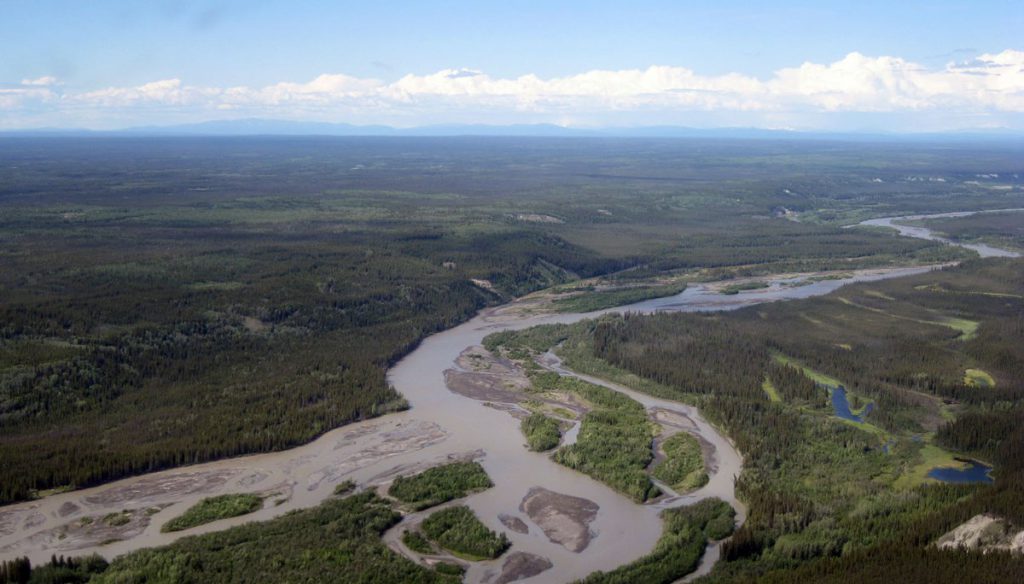
Mountain rivers, especially ones fed by glaciers, will often be braided with numerous channels. These are often an ideal spot to cross rivers. When I did a multi-week backcountry excursion in Wrangell-St.Elias National Park, this was de rigueur. When we took an excursion up the Savage River in Denali National Park, we mostly walked the gravel bars of the river for ease of walking.
The beautiful Copper River in Alaska.
When you do select a site, look for one where you can easily get in or out of the river. Low banks that one can walk into and out of are preferred to a climb in and out of the water.
Preparing Gear and Clothing for Crossings
Waterproof all the things! In this day and age, hikers are carrying far more electronics than ever, and those must be waterproofed. Generally, I keep my entire backpack inventory inside a waterproof, sealed bag inside my backpack.
A lot of people cover these things, but I’ve learned some additional things from military water crossings. If you are wearing pants with cargo pockets, button those or zipper those up. Pockets fill up with water and can weigh you down, and in swift currents, and minimizing that can make an astounding difference.
DON’T WEAR FLIP-FLOPS or OTHER SLIP ON SANDALS. This goes for “crocs,” too. In mild crossings, they may be fine, but in strong currents, they can be sucked right off of your feet, leaving you to walk barefoot on possibly sharp shoes.
I don’t take chances. I take my socks off and inner soles out of my boots, and wear the boots for the crossing. I get the greatest purchase on slippery rocks this way, and I don’t have to worry about a bleeding wound or just stubbing my toe.
Unbuckle the waist and chest straps on your backpack. If you go under, you’re going to want to shed that quickly, lest it drag you down and drown you.
Crossing By Yourself
As an avid solo-hiker, this has been the bulk of my experience.
You should face upstream, slightly sideways. Lean a little bit into the current, which will help you maintain balance. Sometimes, depending on the strength of the current, you may even want to turn sideways, because you’ll be pushed less.
Shuffle your feet along the bottom. Put your downstream foot in the lead. If the water is really cold and the current strong, you may have a temptation to rush, but you’ll want to be slow and deliberate. In Maine, I’ve discovered, the rocks beneath you are often slimy, and it’s very easy to lose balance and fall. With your lead foot, you should also be probing for bigger rocks, holes, downed branches, etc. If you find one, you should try and move around it on the upstream side, as especially in the case of rocks, the turbulence won’t be as significant as it will be on the downstream side.
When possible, you should cross at a downstream angle. Otherwise, you end up fighting the current more than you need to.
This is a strong argument for trekking poles. In recent years, since moving to hammock camping, I’m less inclined to carry trekking poles, but for water crossings, they are very helpful. Put your pole (or a downed branch, never cut a live one) on the upstream side of you, and leaned upon for support. Move the staff first, then slowly shuffle your feet towards it.
Crossing with Others
Fording one of my old favorites, the Eagle River on the Crow Pass trail in Alaska.
Sometimes, a swift river calls for friends. When the river is thigh deep or higher, or the current is heavy, linking arms and taking a go is the best way short of finding another route or crossing.
The largest person should be positioned on the upstream end of the line, with arms interconnected. The group should then cross parallel to the direction of the current, but still at a slight downstream angle. The individual movements are similar to the individual crossing techniques.
It is advisable to put your poles away, unless you are on the ends of the line.
Crossing with Ropes
I would note that it is possible to set up a crossing for others with a rope or ropes, but I strongly discourage it. For backcountry or even major trail travel, if the current is so swift, and there is no permanent fixture, either bridge or wires, it is simply too hazardous a location for crossing.
Swimming Across
Don’t, especially solo. You can certainly float your pack and doggie paddle across, but it’s a terrible idea if you aren’t in a group. Depending on the season or the temperatures, hypothermia becomes a very real concern. I always keep a dry set of things (or at least not too damp) to change into after crossings. I took a dunk on my last trip in the 100 Mile Wilderness in a deluge-swollen creak, and if I hadn’t immediately changed out of soaked clothing, I could have lost too much heat to safely continue.
If you are a solo hiker, please do know everything you can about self-rescue, and how to warm yourself up in case things go sideways.
We’ve been at war for 18 years. I’ve been in the military, between the active duty Army as a paratrooper and the National Guard as a paratrooper, Stryker infantryman, and transportation manager, for 25 years this July. Like any service member with any period of service, there are names we read on Memorial Day that are familiar. It’s a hard weekend, replete with survivor guilt for both combat deaths and suicides.
On Shabbos, I read the names of Jewish members of the American armed forces who have perished since 9/11. It’s a list that continues to grow, and because of “Jewish geography”, more than a few names on that list are people we knew and loved.
My tradition on Memorial Day weekend in recent years has been to eschew crowds, parades, pomp and circumstance, and indulge a period of quiet reflection in the woods. I’ve written on the blog my wife and I maintain about living a Jewishly observant lifestyle in the Maine woods about Judaism having a salve for moral injury, and for me, hitbodedut is a crucial component of that.
Hitbodedut
Rabbi Nachman of Breslov envisioned hitbodedut (“self-seclusion”) as a self-directed means to build a stronger relationship to Hashem. This works for me. On long slogs in the wilderness, I find it easier to talk to the Divine. It’s a little awkward when you walk past a party of other hikers who heard you coming, and then are curious about who you were talking to.
But I have questions.
In October, one of the former members of my old National Guard unit shot himself. He was living with his parents. He came downstairs one morning to where his mother was eating breakfast, told her, “I am in so much pain,” and pulled the trigger.
This hit his friends that knew him more than anyone, I imagine. He’s not the first suicide from my old unit, either, and at this point, we’ve lost more friends to suicide than combat operations.
I needed some time to talk to the Divine, to ask those questions we always ask when we feel like the world is allowed to careen towards oblivion. Why? And for once, I feel like I can tell Hashem that I feel like I’ve been doing my part…so why does the Divine feel like an absentee landlord?
Crossings
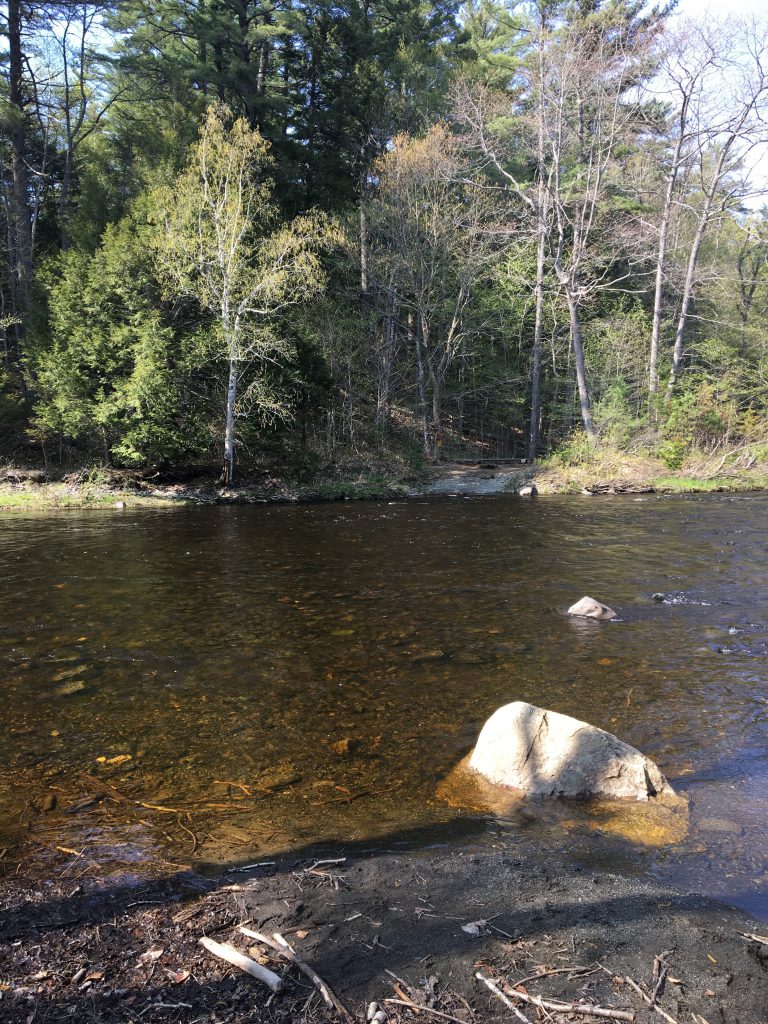
The ford of the Pleasant River on the AT in Maine
Enter the heavy and obvious metaphor. My trip started and ended with the ford of the Pleasant River along the Appalachian Trail. It was bad when I entered the wilderness from the Gulf Hagas parking lot. I lost my water shoes, ended up barefooting more than half of the ford, stumbling across slimy rocks that cut into the bottom of my feet.
When I returned the same way at the end of my trip, the river had swollen even more due to overnight thunderstorms. A couple of fishermen watched incredulously as I crossed the thigh-high water. It was a bad decision on my part, but returning to my car after the miles I put in in the previous days meant either the ford or adding 5-9 miles to my last day. I was exhausted at the end, and made the choice just to risk it. After all, I had made wilder and more dangerous crossing in Alaska’s backcountry, no? What was a rain-laden river compared to a rain-, snowmelt-, and glacial melt-fed river in Alaska?
Well, that was 20 years ago, and I’m not in the same shape, no matter how rugged I believe myself to be. But the crossing – I felt like I was entering something and departing something special. And most would I agree that I was – Gulf Hagas is one of the natural wonders if Maine, and in a world where we’re accustomed to high degree of accessibility, the sense that one has to “earn” those views added a sense of almost holiness to the experience.
The Fall
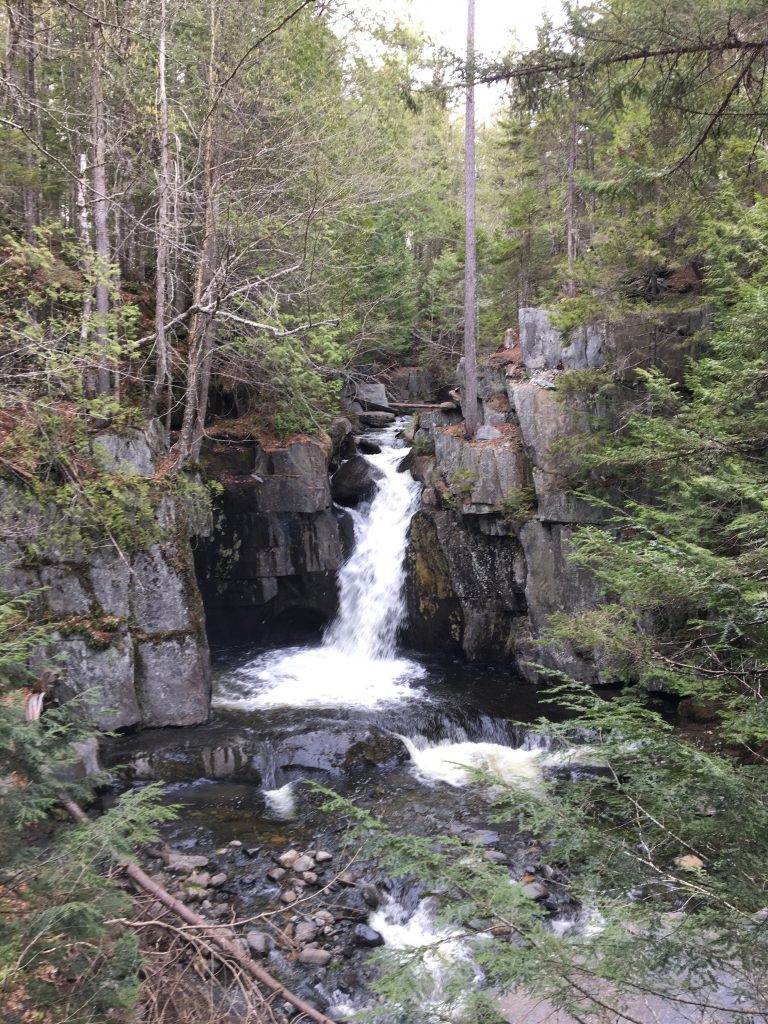
Gulf Hagas is, of course, spectacular. As I stood before each cataract, like Screw Auger falls, I’m reminded that the world that I believe was set in motion by a benevolent Creator is itself transcendent. We spend so much time inhabiting these moments in time, and I can only wonder if we got more veterans with the same blight on their souls in front of natural wonders, if they could gain some helpful sense of perspective?
But then, I think that trivializes how people relate to their every day. For the veteran, or anyone, struggling with addiction and mental issues beyond their immediate control, perspective doesn’t alter brain chemistry the way we’re finding that trauma does. It may well be a component in healing, but only magical thinking affords us the concept of a single, cathartic experience, or set of experiences, that bring people closer to healing, or at least, the elusive Golden Mean.
A gorgeous backcountry waterfall isn’t going to end the ongoing intrusive thoughts we live with. It’s not going to undistort the way a veteran suffering from PTSD sees themselves.
It’s such a nebulous thing, what causes this trauma for veterans. Perhaps it’s an easy answer – a firefight, a battle, an IED that blew up a comrade. Perhaps it’s the sustained tension of day after day of long patrols, and the repeated delve into that anxiety.
Really, can anything offset the loss? The loss of friends, the loss of sense of self, the loss of any semblance that one is safe and secure…these things are haunting.
Journey’s End
As I approached the Carl Newhall shelter after hiking the Gulf Hagas trails followed by 3.5 miles on the AT heading north, most of what I felt was fatigue. My brain stopped lingering on names like James C. Wilson, Chad Edmundson, Stuart Wolfer, Daniel Agami, Blake Miller, Eddie Zorak, and focused on putting one foot in front of the other.
A small pond along the trail echoed with the chirping of spring peepers and birds as evening fell. The air was pregnant with a looming storm.
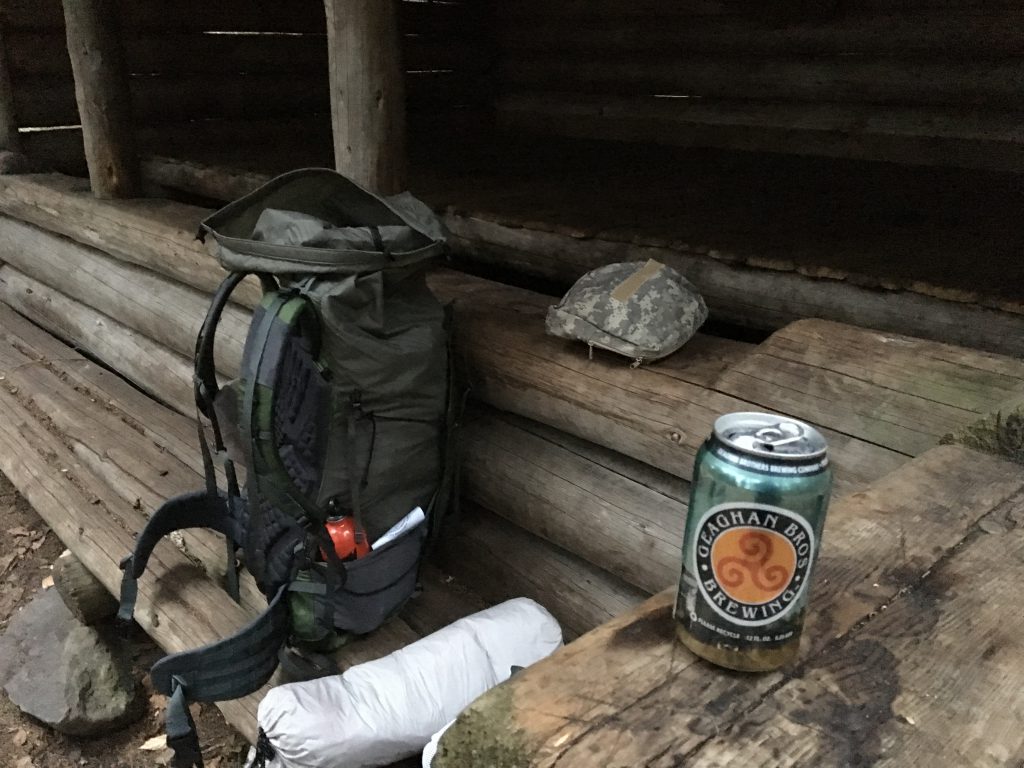
One stream remained between myself and the shelter, and a well-earned Bangor-brewed beer (a favorite of my rabbi’s), and some Tasty Bites Vindaloo.
I start unpacking at the shelter.
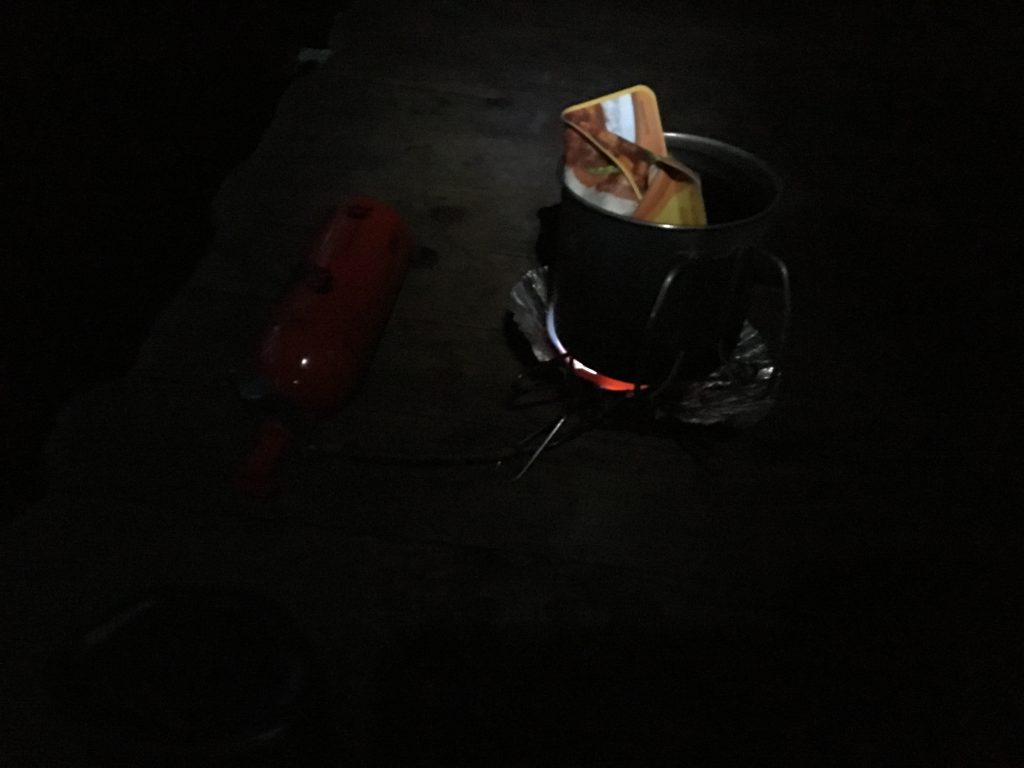
The rain didn’t start right away. I changed out of sweat dampened clothing into the dry things I kept in my bag. The temperature began to drop into the mid 40s, so I put on my down jacket. I finished my beer and started boiling the water for my vindaloo, as well as some hot cider.
Not from the Battle of Winterfell, my 20+ year old WhisperLite heats my vindaloo.
The darkness came on quickly. The vindaloo caused heartburn as I settled into my sleeping bag. The pain in my stomach made it harder to sleep than the percussion of the rain on the shelter’s tin roof.
When the heartburn finally subsided and I did fall asleep, I realized that my own soul was once again at peace, at least in that moment. Still, something gnawed at me.
In a year’s time, Memorial Day will come around. New names will be on our lists that we read. More veterans will have taken their own lives. The war will likely still rage on at the fringes of American awareness, and little will change.
That’s how life is between Memorial Days, even punctuated by soul-inspiring dips into the raw parts of Creation. It’s just like humankind’s perpetual relationship to our Creator.
There is a candidate for a state house race here in Maine, she’s what I’d call a “super Christian.” Along with that comes, for good or for ill, a profound ignorance of other faiths, possibly even within her Christian fold. I noted one of her (incidentally) anti-Semitic social media posts was that Judaism was “terrible for women” until Jesus Christ came along. Naturally, I disagreed, but I checked with my wife first, to see if I did really disagree.
My true response is a snort, and a pointing finger at Parsha Pinchas, specifically the Daughters of Tzelafchad. A census is taken, counting only the men, and the daughters of Tzelafchad, who didn’t join Korach’s rebellion, stand before the tent, and petition Moses (and subsequently, G-d), to allow them to inherit their father’s portion, rather than divvy it up among their clan and tribe. The law of inheritance is modified, by G-d, to allow women to inherit their father’s land if he has no sons.
I always love this parsha for two reasons: Divine law is mutable, and divine justice is available to anyone, even in our own sometimes male-dominated tradition.
There is a chassidic tradition that each generation of Jews relives (I found this here) a measure of the Israelite time in the wilderness on the way to inheriting the land. The daughters of Tzelafchad make their plea in Moab, right after Balak retains Bilaam to curse Israel, right before they come into the land. Accordingly, they believe this will be one of the last stages on the way to messianic redemption…is the explosion of female rabbis in all denominations, and the increasing presence of learned women in Orthodox Judaism a messianic portent?
This is a hiking website, so we’re not going to delve into that here. It’s just fascinating to me, personally.
Instead, I’d like to focus on a recent obituary (long in coming) that appeared in the New York times about the pioneering early thru hiker of the Appalachian Trail, Emma Gatewood. This was a woman that survived abuse, and humbly but firmly staked her claim on the Appalachian Trail, just as the daughters of Tzelafchad did. The shame of it is, many of us knew of Gatewood first as the veteran voice, channeled to disapprove of overly geared thru-hikers. What we find out is that like the daughters in Parsha Pinchas, Gatewood emerged from out from under an androcentric 1950s world to assert her role; and it’s still shaping perceptions of the Appalachian Trail to this day.
One thing I’ve observed since the 1990s, from the Appalachian trail to the Alaskan backcountry, women are starting to take up their wilderness inheritance as well. There are setbacks. Geraldine Largay’s wrong turn, the double homicide of Julie Williams and Lollie Winans (still unsolved), or the murder of Rebecca Wight, to name a few. These things easily happen to men as well, but there is often an undercurrent of sexualized violence against women when it occurs, and a greater sense of urgency to lost female hikers.
Today, at least 25% of thru hikers on the Appalachian Trail are women. I didn’t research statistics for the Continental Divide Trail or Pacific Crest Trail, but based off video diaries and travel blogs, my sense is they’re on the rise on those trails as well.
Emma Gatewood slept under a shower curtain. Women are breaking thru-hike speed records. I’m seeing groups of women on trails.
In the Jewish world, just as we’re seeing spaces for women opening in scholarly pursuits, just as we’re seeing female infantry units in Israel, we also need to ensure we’re creating the space for frum Jewish women in the woods. We face challenges (some of which we talk about in our book, The Kosher Backpacker), but they can be overcome.
We must strive to add Jewish women’s voices to our American wilderness inheritance.
This is a modified version of the foreword that appears in my book, The Kosher Backpacker, as an introduction to this site.
– Brian Kresge, aka “Strings Attached”
I saw a mountain lion in the Adirondacks.
It was a long, humid weekend in the early 2000s.My late Labrador Retriever, Max, and I took in a backpacking trip in the High Peaks.The humidity became rain.This seemed to discourage too much backcountry travel, as Max and I had the woods and peaks to ourselves.The ceiling was still low enough to command decent views, so we still ascended Lower Wolfjaw.
Coming down Bennies Brook Slide was shaping up to be a monotonous, slippery mess.I happened to glance back up towards the peak, and I saw a brown shape saunter out of the woods on the right side.
It looked at me.
I looked at it.
You hear sightings like this year after year, but none of them are proof that the Eastern Mountain Lion is not extinct.I know what I saw, but I had a suboptimal digital camera, the kind that barely took decent resolution photographs, and in those days, I kept it in the top of my back, not easily accessible.I cannot prove what I saw, and even if I had taken a picture, my candid-capable camera would have produced a questionable fawn splotch against the gray and green background.
It’s still one more mountain lion than I’ve seen observant Jews on “the long trail.”
When I’ve hiked through the northeastern Pennsylvania, New Jersey, and New York sections of the Appalachian Trail, or in the Catskills, or when I’ve been on hikes through popular areas of the White Mountains, I’ve met families of religious Jews.In all cases, it was a day hike.
I have yet to meet a Torah-observant Jew on a thru-hike.I don’t believe it’s because Jews don’t have a relationship with the outdoors, or our summer camps wouldn’t be as central to young Jewish identity as they are.This also isn’t to say there aren’t any or haven’t been any—after all, if you’re reading this, you know of at least one.We may not literally have crossed paths.
This website is designed to be a compliment to The Kosher Backpacker, but also as a resource to Jewish and non-Jewish hikers alike. Kosher recipes, halachic guidance on aspects of hiking and thru hiking. We’ll even help you with your own trail journal. We have a suite of apps for kosher backpackers, including a GPS-enabled Appalachian Trail guide. We will, as time permits, add Pacific Crest and Continental Divide Trail guide apps as well.
After a test of my RAV4’s tires and suspension coming down a 4.5 mile stretch of rocks and pits, Amelia and I stood on the perhaps manufactured beach along the Debsconeag Deadwater at Omaha Beach. We were swarmed immediately by Maine’s patent cocktail of black flies and mosquitoes, in spite of our best efforts with bug spray. The nearby campground was filled with loud people. I try not to be terrifically negative about “car campers,” as I’ve been one, but I find their presence in the wilderness intrusive, since they merely trade tent for house and drag along generators and radios. Attempting to duplicate the comforts of home in a wilderness setting is, to me, ridiculous. I’m not sure what bothered me more: the insects or the blaring country music. I could understand this at a trashy trailer lot “campground,” but given the inaccessibility of this serene locale off of the Golden Road, it was horribly out of place and diminished the character of the wilderness.
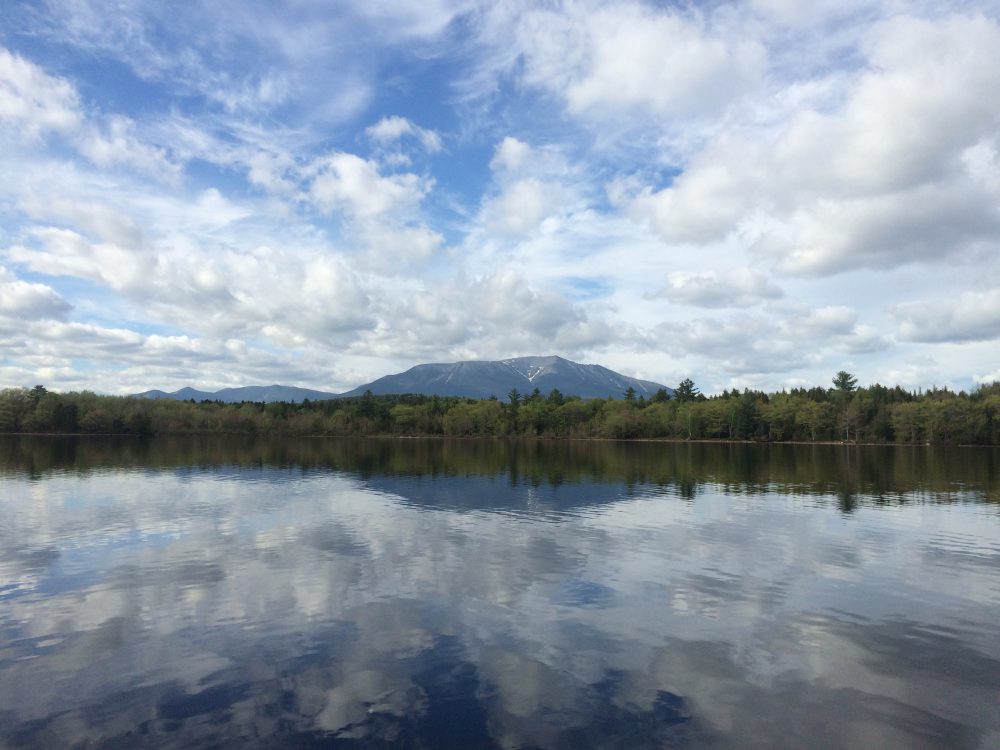
Amelia enjoys some wading with Katahdin in background.
This part of the West Branch of the Penobscot barely had a discernible current (hence “Deadwater?”). As we put in and paddled away from shore, the bugs subsided. We headed west towards the inlet into First Debsconeag Lake, the alternating depths affording Amelia an opportunity for some wading. The water was so still, and in the distance, the clouds cleared and we could see the lingering rivulets of ice in the spurs on Mt. Katahdin in the distance. Once we got away from the din of the campground, the quiet was only broken by our conversation and our wooden paddles breaking the water.
As we paddled towards the inlet from the Deadwater, on the left bank we saw some tell-tale sign of beavers. Gnawed stumps, trees that were obviously “works in progress” by the prodigious rodents, and logs fallen into the water, but no sign of actual beavers. As we rocked back and forth in the wake of a motor boat, we didn’t speculate long on the beavers’ invisibility.
Our goal was to make it across the First Debsconeag Lake, take the portage to the Second, and find a wilderness campsite there. The campsites along the First Debsconeag were generally occupied by waterborne variants on the class of campers at Omaha Beach. They arrived with larger, motored watercraft, unloaded their “camp,” and polluted with noise ill-suited for the wilderness. We knew taking the path to the Second Debsconeag Lake would take us away from this, as it was unattainable for people accustomed to easy travel.
Unfortunately, the portage was unattainable for us, as well. Amelia was determined to do it. As I scouted ahead, she tested the scag-wheel built into the aft of our vessel by pulling it a good distance down the trail on her own. Sadly, our canoe is 94 lbs with no yoke, our gear was slightly heavy, and it just wasn’t realistic, even for a quarter of a mile. We ran the risk of scraping the bottom of the canoe absent a decent terrain-friendly cart. Next time we’ll be better prepared.
We acknowledged as we retreated back across the first lake that we would have to look for an empty spot alongside the offensive sprawl of the other campers. We found one initially, only to have the helpful residents of one camp point us to a quieter, less obvious spot on the other side of their camp. For all the fault I find with their form of camping, I’ve never encountered a group that are not marvelously friendly. They even gave us some of their wood and lit a fire while we set up camp as twilight descended.
After that, we roasted KforP marshmallows from our considerable stash Leah gathered from the Pesach clearance at Shaws or Hannaford. Amelia relaxed in the hammock, until we went to bed. In the morning, I woke up for my morning ablutions and laid tefillin under the cover of trees, after which I took in the morning light and looked without success for a moose or two. When Amelia woke up, we had a breakfast of oatmeal and coffee singles, then put in, and returned home.
This trip was why we moved to Maine. Amelia and I have put our feet to most of the hikable east coast. I’ve put my feet to most of the the continent, from Alaska to Florida, but there’s nothing quite like the tranquility of paddling in Maine.